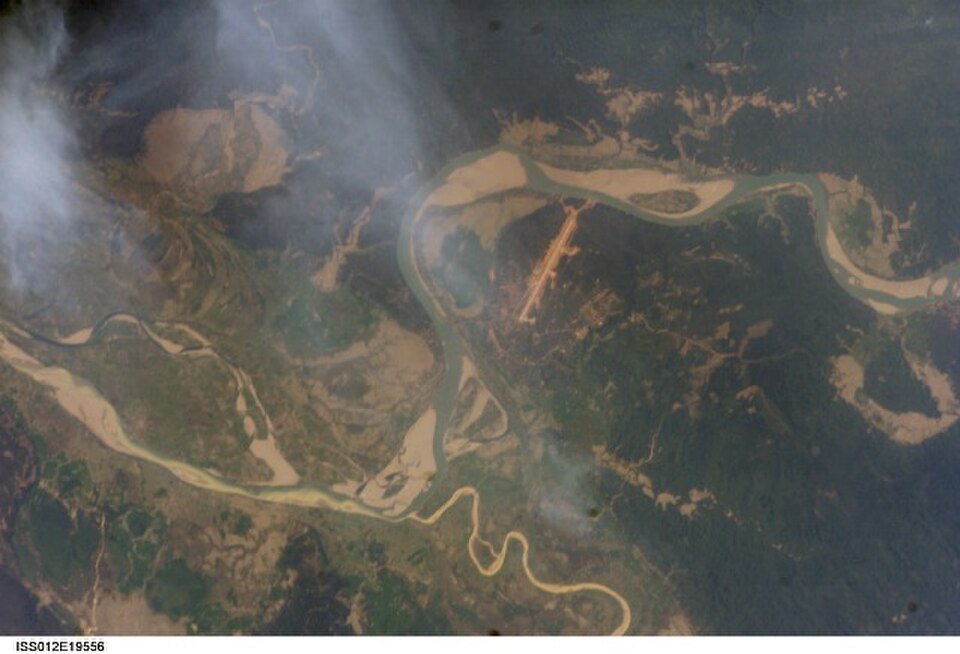
An aerial view of the Homalin settlement and the Chindwin River in the Sagaing Region of Myanmar. (Wikimedia)
On April 20, a blaze broke out from an oil terminal in Homalin Township at Myanmar’s northwestern Sagaing district—one of the country’s busiest trading hubs.
Authorities arrived immediately, deploying firefighters and confirmed that the incident killed two people and injured at least 11. Locals reported that the river port continued burning until the following morning, with fears that the casualty toll had risen. Though the blaze was eventually brought under control, full extinguishment is unlikely within less than a week.
Preliminary indications suggest the fire was triggered by overheating during a routine fuel-loading operation, swiftly destroying 22 vessels and two vehicles. Further details on losses have yet to be disclosed as the investigation remains ongoing. What is certain is that those ships carried thousands of barrels of fuel.
The energy shortage brought on by the Middle East war has exacerbated Myanmar’s already unstable domestic order and further weakened supply chains for developing countries—nations that had already struggled to achieve energy security even before the crisis.
The incident underlines the urgent need for technical and safety evaluations, as Homalin is not an isolated case. In the 45 days since the US-Israel war on Iran began, more than 45 fires have been reported at oil refineries and power plants worldwide—a staggering increase of roughly 1,800% compared to the 9 to 10 such incidents typically recorded in an entire year.
What does this mean for businesses?
Oil reserve holders and exporter nations—among them the US, Russia and select Gulf states—profit from the continuously high oil prices as scarcity remains, as tightening supply drives demand and strengthens their currencies.
For emerging markets, the picture is the opposite. Capital outflows are undermining supply chains and making foreign investment—which is important for economic growth for developing nations across Southeast Asia—increasingly difficult to attract. This has contributed to the currency weakening observed across the region since early April. Once energy insecurity reaches the household level, as it already has in Myanmar, it risks destabilising not only the country’s economy but also politics.
About The Author