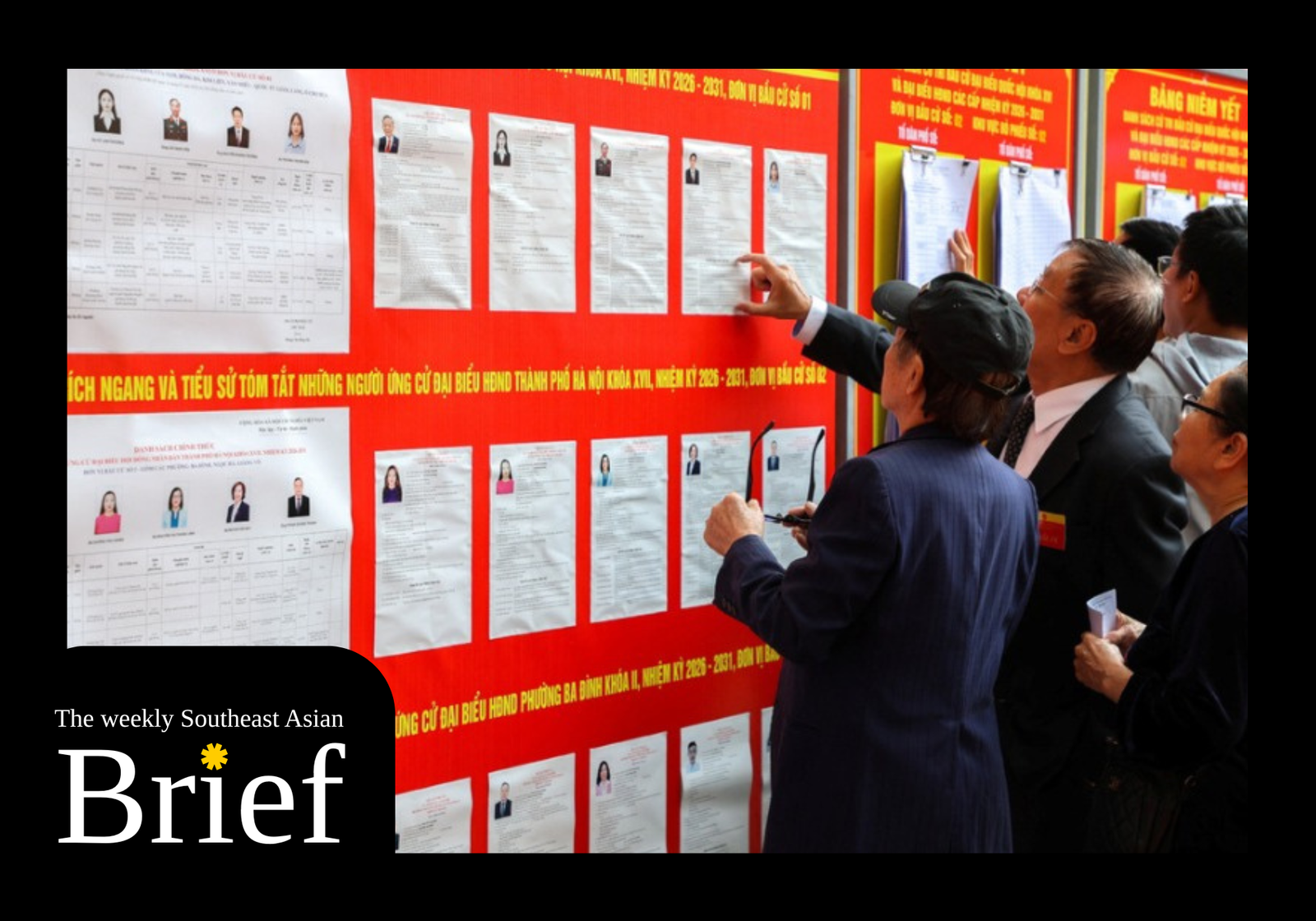
People look at a board with information about candidates outside a polling station during a parliamentary election, in Hanoi, Vietnam, on March 15, 2026. (China Daily)
On March 22, Vietnam’s National Election Council (NEC) announced the results of the elections organised a week prior to elect members of the People’s Councils on the provincial and commune levels as well as 500 representatives to the 16ᵗʰ National Assembly. Trần Thanh Mẫn, the chairman of both the National Assembly and NEC hailed the 99% turnout, which is equal to 76 million voters. He was one of the 500 elected National Assembly representatives, alongside with Communist Party of Vietnam (CPV) General Secretary Tô Lâm.
The first session of the National Assembly is set to take place between April 6 and 25, where lawmakers will approve candidates for top state posts, including the chairman of the National Assembly, president, the prime minister (PM), chief justice of the Supreme People’s Court, and prosecutor general of the Supreme People’s Procuracy.
In Vietnam, the president serves as head of state, representing the nation domestically and internationally, while the PM leads the government and executive branch, managing day-to-day administration and implementing laws and policies. However, current PM Phạm Minh Chính has recently represented Hanoi more on the international stage, signing strategic deals and leading Vietnam’s global economic integration.
Following PM Chính’s success in reviving Vietnam’s post-pandemic economy and actively promoting global economic integration with significant development indicators, the new PM is expected to move in the same economic trajectory. They will be expected to push productivity, develop human capital and strengthen the role of the private sector, while developing Hanoi’s industrial base of emerging technologies, including artificial intelligence (AI), semiconductors, and renewable energy.
Crackdown on corruption is also projected to continue in a more vigorous manner, as advocated by CPV Secretary-General Tô Lâm—who holds the most influential post in the country. This continuity narrative led external observers to predict that the PM role will be held by Lê Minh Hưng, former Governor of State Bank of Vietnam and Head of CPV’s Central Organisation Commission—which advises the party’s political trajectory and internal security of the party.
However, this free market approach will not be without challenge. Vietnam is heavily hit by the consequences of the Middle East conflict. Around 85% of its crude oil imports come from the region, leading to an increase of 50% in petrol prices. The new administration will thus need to find a delicate balance between maintaining Vietnam’s open market approach while insulating itself from global crises, which will have implications to its hedging strategy on the global stage.
About The Author