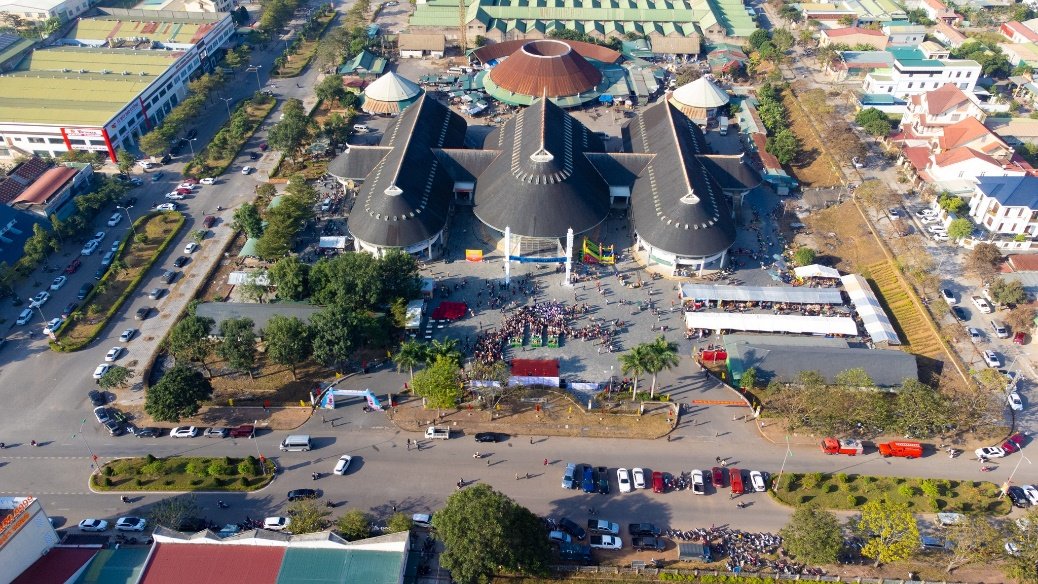
Lao Bao border market, a key trading hub along the Vietnam–Laos frontier. (Lan Homi)
Around 400 delegates across the provinces along the planned railway lines from the three countries gathered to discuss the routing and development plan. The most discussed sectors were infrastructure and investment cooperation, intending to turn the areas into a regional mobility hub.
At the same time, the Vietnam-Laos Investment Forum was held on April 3-5, 2026 to discuss the 1,450-km linkage. As a result, 20 memoranda of understanding (MoUs) were signed between Vietnamese provinces and Lao partners.
The EWEC was first established in 1998 as a part of the Asian Development Bank (ADB) flagship programs to spur economic development and growth. The project connects Myanmar, Thailand, Laos and Vietnam, stretching from Yangon to Da Nang.
In 2006, the Second Thai-Lao Friendship Bridge (Mukdahan–Savannakhet) was built, physically connecting Thailand and Laos via a modern road bridge. The corridor was officially opened for international transport in December 2006. By early 2010, Vietnam underwent a significant project upgrade along its Highway 9 and the Hai Van Tunnel to ease the mobility of heavy cargo from the Lao border to the deep-sea port at Da Nang.
What does this mean for business?
This construction will have a significant impact on the economic sector. First, the bilateral trade volume between Vietnam and Laos accounted for almost $3 billion in 2025. This will significantly grow as the corridor logistics have improved.
Moreover, since 2025, Quick Response (QR) code services have been available in Laos, Thailand, and Vietnam, making it easier for small and medium entreprises (SMEs), large business enterprises and tourists along the corridor to conduct payment. This is in conjunction with the Vung Ang port expansion and advancement of the Lao Bao Special Economic–Trade Zone, which aims to accelerate the region’s economic integration.
About The Author