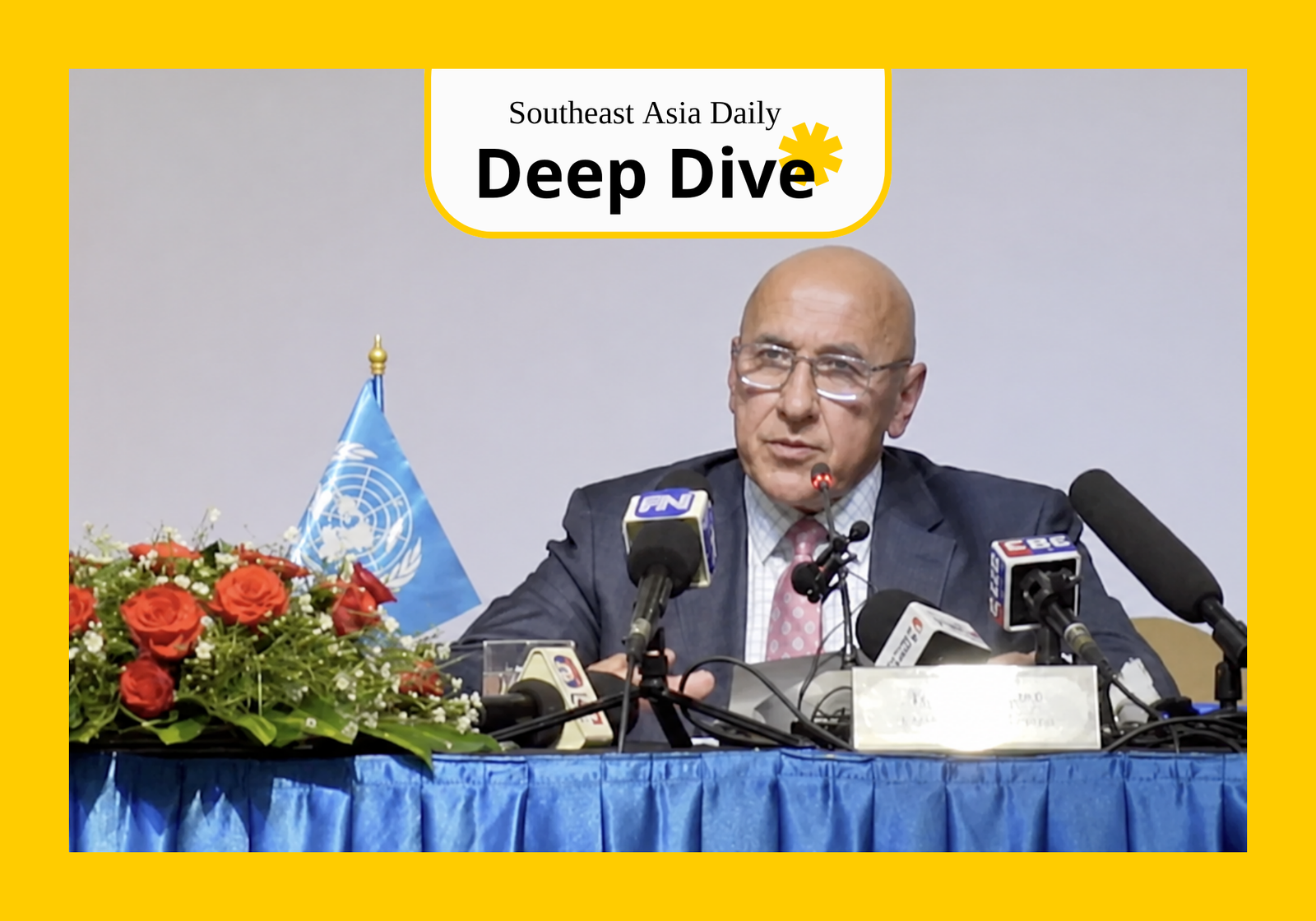
UN Special Rapporteur on the situation of human rights Tom Andrews during a press conference in Phnom Penh Cambodia on July 31, 2026. (UN Special Experts)
Four Disputes, Two Legal Tracks
More than one year after gunfire first broke out along the Preah Vihear temple complex, specifically on May 28, 2025, the Thai-Cambodian border dispute is back in the headlines through an unlikely channel: a UN human rights mandate. On 31 July 2026, Tom Andrews, UN Special Rapporteur on the situation of human rights in Cambodia, closed his first official mission to the country with an end of mission statement that devoted several passages to the border conflict, including a call on both governments to allow the safe return of displaced civilians. Bangkok rejected it within 24 hours, and the exchange escalated over the following week into a formal diplomatic note to the UN High Commissioner for Human Rights.
The dispute traces to differing interpretations of maps drawn under the 1904 and 1907 Franco-Siamese treaties. The International Court of Justice (ICJ) ruled twice on the resulting Preah Vihear flashpoint, in 1962 and again in 2013, both times affirming Cambodian sovereignty over the temple. Four other contested areas, Mom Bei, Ta Moan Thom, Ta Moan Toch and Ta Krabey, remained undetermined.
A skirmish at Mom Bei on May 28, 2025 killed one Cambodian soldier. Fighting escalated across multiple border points from July 23 to 24, including Thai airstrikes. The toll reached over 100 dead and up to 800,000 displaced at its peak, before a ceasefire on December 27 last year. Roughly 400,000 people remained displaced as of January 2026. Malaysia’s 2025 ASEAN chairmanship convened several Kuala Lumpur talks between the two governments, sealed as the Kuala Lumpur Peace Accord at the 47thASEAN Summit in October 2025, which established the ASEAN Observer Team to monitor compliance. Analysts attribute the de-escalation more to Trump’s tariff-linked pressure and parallel Chinese engagement than to any ASEAN mechanism. The chairmanship passed to the Philippines in 2026, and another flare-up has been flagged as plausible in the second half of the year. On July 2, Cambodia lodged a formal protest over Thai personnel entering territory near Khnar Temple without notice, followed a day later by a second protest over barbed wire installed at Mom Bei and in Oddar Meanchey province. Phnom Penh called the wire a breach of the December 2025 General Border Committee (GBC) framework. Bangkok defended it as defensive infrastructure erected inside Thai territory.
Two international tracks are running in parallel. Cambodia filed notice with the ICJ in June 2025 over the four remaining areas, but the case sits frozen because Thailand, like 118 other UN members, does not accept the Court’s compulsory jurisdiction. The UN Human Rights Council track, via Special Rapporteur Tom Andrews’ July 2026 mission and end of mission statement, drew an immediate rebuttal from Bangkok. Both illustrate the limits of international legal mechanisms absent a party’s consent, a point this piece returns to at the end.
Why Each Side Picks Different Forum
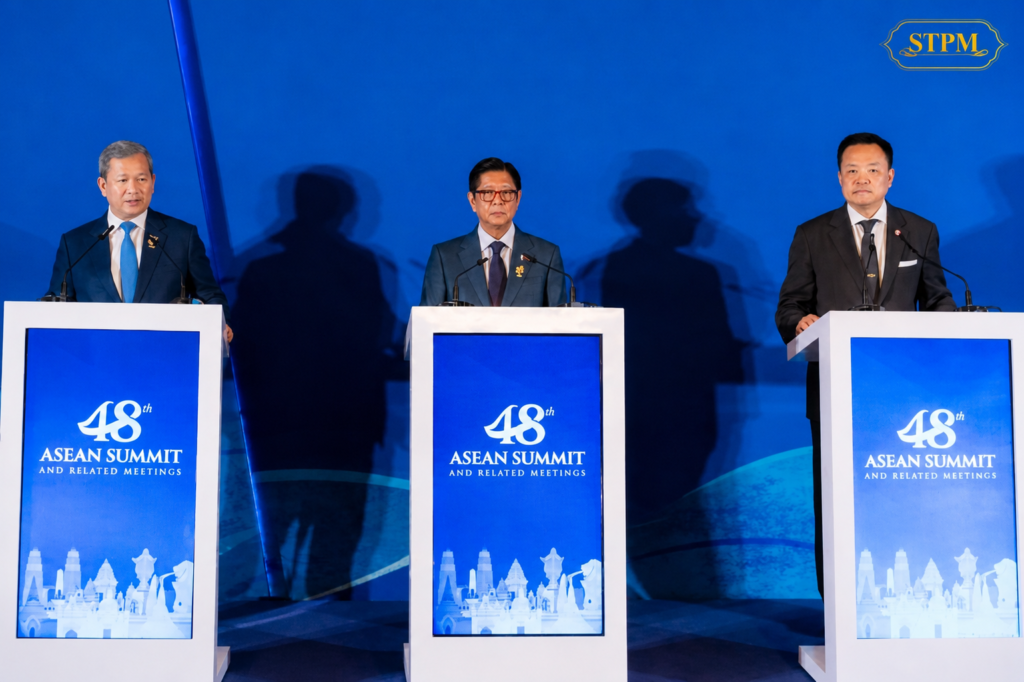
Cambodian Prime Minister Hun Manet, President of the Philippines Ferdinand Marcos Jr. and Thai Prime Minister Anutin Charnvirakul in a joint press conference following their trilateral meeting in Cebu, the Philippines this evening, on the sidelines of the 48th ASEAN Summit in May 2026. (Cambodian Prime Minister Office)
ASEAN and UN: The Consent Asymmetry
ASEAN’s non-interference and consensus norms have confined the conflict to informal, chair-led diplomacy. No formal mechanism has been invoked. The High Council established under the Treaty of Amity and Cooperation has never been activated in this conflict, nor in the bloc’s history since the treaty entered into force in 1976, and neither the ASEAN Charter’s good-offices provisions nor its 2010 dispute-settlement protocol has fared any better. Both depend on the consent of every party, so a government that does not want mediation can simply decline it.
The UN human rights system operates on a different logic. Investigating and reporting on Cambodia’s human rights situation, including the effects of the border conflict, requires neither Thailand’s consent nor ASEAN’s. Special Rapporteur mandates are established by the Human Rights Council and carry out their work regardless of whether the state under scrutiny cooperates. Andrews’ mission proceeded, and his end of mission statement was published, without Thailand holding any formal veto over either step. That asymmetry, one system built on withholdable consent, the other built to function without it, is the fault line the rest of this dispute runs along.
Consent-based mechanisms also carry a domestic political logic that makes them attractive to decline. Opposition politicians in Thailand attacked a government-backed proposal for joint development in the border region as a prospective loss of territory, intensifying nationalist rhetoric on both sides and hardening each government’s incentive to avoid any process that could be read domestically as conceding ground. A High Council hearing, or an ICJ case Thailand actually joined, would generate exactly that kind of politically costly record. UN Human Rights Council (UNHRC) scrutiny, by contrast, does not require Bangkok’s agreement to convene, so opposing it carries no domestic cost beyond the dispute itself.
Cambodia and Thailand: The Incentive Gap
UN Special Rapporteur’s mission introduced a human rights and accountability frame onto a dispute ASEAN had kept narrowly bilateral. Cambodia has more to gain from internationalising the dispute than Thailand does, evident in the ICJ filing and in the access it granted Andrews for his mission, because bilateral and ASEAN-level negotiation favour the militarily stronger party. Thailand’s preference for containment follows the same logic in reverse. Its two-stage response to the end of mission statement, first disputing Andrews’ claim of roughly 650,000 people displaced at the conflict’s peak and 900,000 Cambodian migrant workers returned from Thailand, arguing the figures conflated decades-old shelter populations and undocumented labour with the current crisis. Then he disputes his consultation process via a formal diplomatic note alleging he failed to properly engage Thai authorities before publishing, functions as an attempt to contain a frame Bangkok cannot block outright and to reassert control over a mechanism it did not invite.
The same calculus appears in a second, parallel track. ICJ and UNHRC sit at opposite ends of a consent spectrum: full prior consent required for the former, which is why Thailand can simply refuse it, none required for the latter, which is why Thailand can only contest it, not block it. UN Convention on the Law of the Sea (UNCLOS) Annex V compulsory conciliation highlights that a state cannot refuse to participate once conciliation is invoked, but the resulting recommendations carry no binding force, a structure with precedent in the 2016 Timor-Leste v Australia case, the only prior instance of the mechanism running to completion. This is precisely the track Thailand and Cambodia are now running over a roughly 26,000 square kilometre area of overlapping maritime claims around Koh Kut Island, after Thailand scrapped a 2001 memorandum on joint boundary and resource negotiations. Thailand agreed in July 2026 to delay appointing the Commission’s chairperson without shifting its underlying legal position, engagement without exposure. It is not that Thailand rejects international mechanisms wholesale, but rather calibrating its engagement to how much binding authority each mechanism actually holds.
Parallel Tracks
Cambodia runs a portfolio approach across ICJ, UNCLOS conciliation and UNHRC scrutiny simultaneously, a reasonable posture for the militarily weaker party, which has comparatively little to lose if any single track stalls. Thailand’s posture is not blanket refusal but selective engagement calibrated to bindingness, participating where outcomes cannot bind it, contesting or declining where they can.
The bloc’s structure has preserved a channel for de-escalation, the ceasefire, the General Border Committee meetings, the ASEAN Observer Team itself, but it has never produced enforcement. Nearly a year after the first shots were fired, Philippine President Ferdinand Marcos Jr, the current ASEAN chair, brought Cambodian Prime Minister Hun Manet and Thai Prime Minister Anutin Charnvirakul together in Cebu, the clearest sign that the bloc’s informal channel still has some life left in it, even as its formal tools remain untouched. That gap is where the UN’s parallel, consent-independent tracks are now doing work ASEAN’s own architecture was not built to do. Two multilateral systems, one anchored in sovereign consent and consensus, one increasingly willing to act without either, colliding over the same unresolved territory.
Tests Ahead
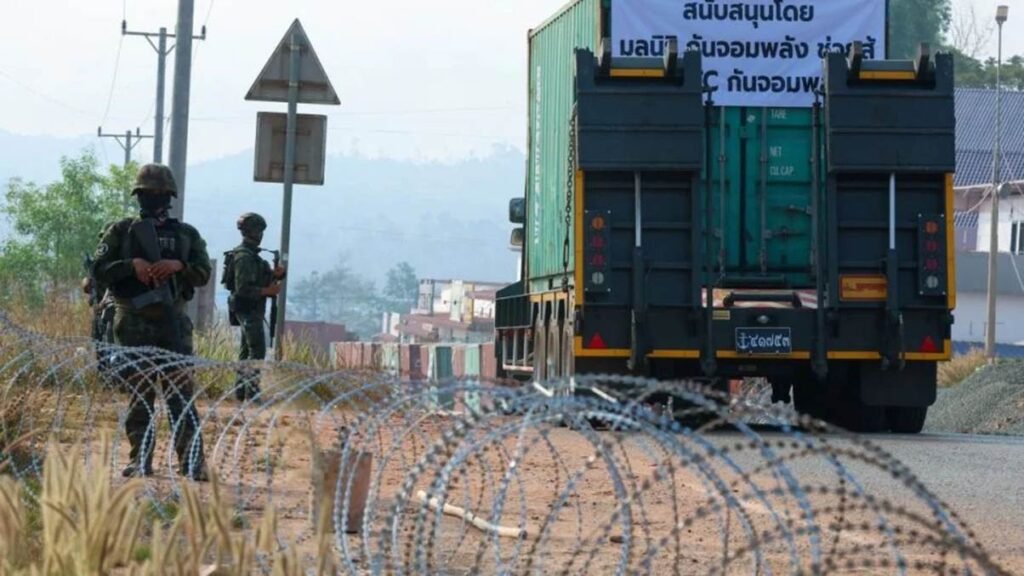
Thai soldiers stand next to barbed wire cordoning off an area at Thma Da on February 7, 2026. (AKP)
October 2026 will test whether Thailand engages with the UN Special Rapporteur Andrew’s full report to the Human Rights Council or continues to contest the process itself, and whether the Gulf of Thailand conciliation has produced any movement by then. The five-member Commission is otherwise in place, missing only its chairperson, so progress before then will be procedural rather than substantive. Plus, a third flare-up, plausible in the second half of 2026 by regional risk analysts’ own reckoning, would test which track carries more real leverage in the end. ASEAN’s quiet diplomacy or UN scrutiny, or whether neither meaningfully affects the underlying territorial and maritime questions still sitting before a jurisdiction-less ICJ and a non-binding conciliation commission. A fourth GBC meeting or a fresh Kuala Lumpur-style intervention would suggest ASEAN’s channel still has some capacity left. A further round of diplomatic notes contesting the UN process would suggest Bangkok has decided containment is cheaper than engagement.
Two questions remain open. First, whether international legal mechanisms retain force when a party withholds consent, as Thailand has with the ICJ and, more selectively, with the Human Rights Council. And second, whether the Special Rapporteur mechanism’s own credibility survives becomes contested terrain in the dispute it was sent to examine, given that Andrews’ figures and his procedure are now both objects of formal dispute rather than settled findings. None of this settles the underlying sovereignty questions, at Preah Vihear, at Mom Bei or in the waters off Koh Kut. What the past year has settled is which forum each side trusts to work in its favour: Cambodia the ones it can invoke without Thai consent, Thailand the ones it can slow-walk without ever having to say no. Neither forum was designed with the other’s blind spot in mind, and neither side seems inclined to let that stop it.
About The Author