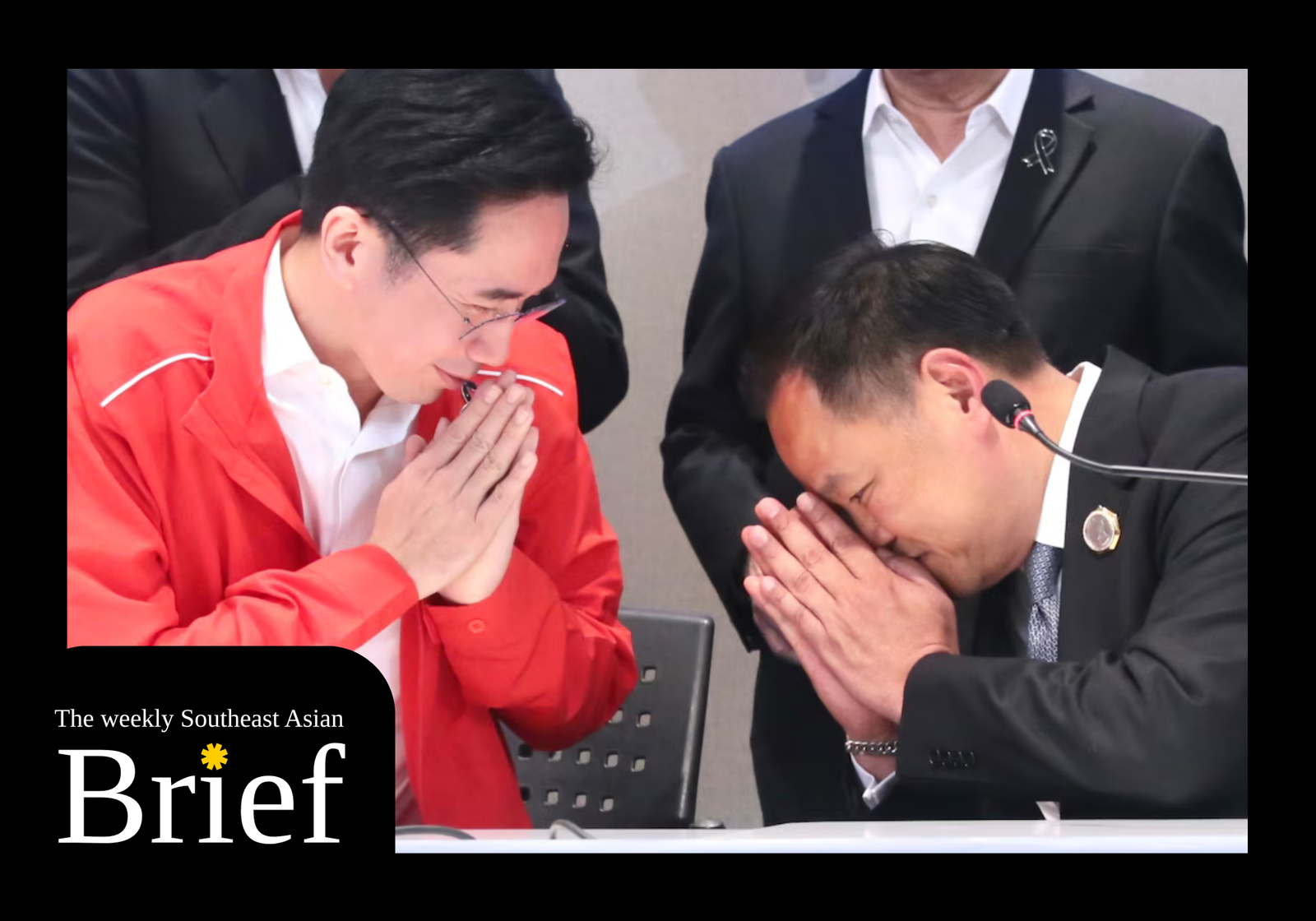
Pheu Thai Party prime minister candidate Yodchanan Wongsawat greets Thailand’s Prime Minister and leader of Bhumjaithai Party Anutin Charnvirakul at Bhumjaithai, the party headquarters in Bangkok, Thailand, on February 13, 2026. (Bhumjaithai)
On February 8, Thais voted in a snap election following the dissolution of parliament announced in December 2025 by Prime Minister Anutin Charnvirakul. It resulted in the shocking victory of the conservative Bhumjaithai Party, who secured 193 seats in a 500-seat assembly.
The progressive People’s Party (PP), projected to win by earlier polls, only won 118 seats while the conservative-liberal Pheu Thai Party claimed 74 seats.
Bhumjaithai and Pheu Thai have formed a conservative government led by the former, with the newly-formed conservative Kla Tham party, who secured 58 seats, expected to join.
To note, this marked a sharp contrast to the 2023 elections, when the left-leaning Move Forward Party (MFP)—the de facto predecessor of PP—won the largest share with 151 seats albeit not being able to form a government as the Pheu Thai (141) and Bhumjaithai (71) formed a conservative coalition.
In the 2026 elections, support for conservative parties is prominent in rural areas, as opposed to the PP-leaning urban voters.
Interestingly, although PP secured a total landslide victory in every area of capital Bangkok and the adjacent province of Nonthaburi; all the other provinces were either contested between conservatives, or won outright by Bhumjaithai.
One possible reason behind the result is the fact that many rural voters prefer the populist approach of the conservatives —which include daily necessities subsidies—rather than taking a risk with lengthy and possibly unstable reforms promised by the PP.
In addition, the conservatives also fielded strong local candidates whose presence in the countryside is deeply embedded in the local social structure, acting as local benefactors of the party.
Conversely, 65% of voters agreed to rewrite the constitution in a referendum held on the same day as the elections. The reformists can claim this victory as the constitution was drafted under a 2017 military government, giving them seats in Thailand’s upper chamber and practically allowing them to have the final say in political matters.
However, since the process will be carried out by a conservative government, it is yet to be seen whether the change will truly be as reformative as the voters initially had hoped or not.
Suppadet Auttasiriluxe is a political analyst on Southeast Asia from Thailand.
About The Author