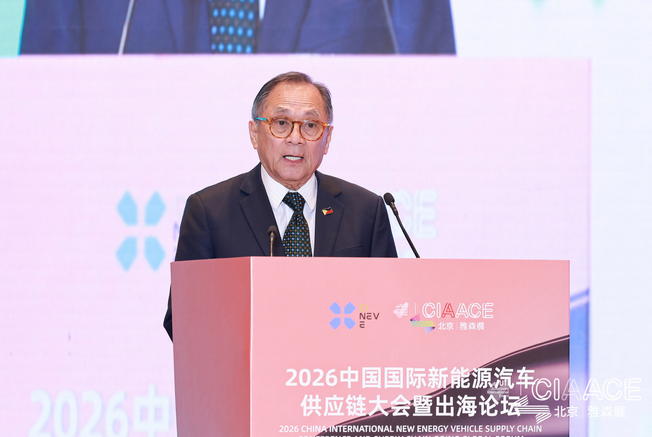
At the CINEVE 2026, Philippine Ambassador to China Jaime FlorCruz pitched the Philippines as an ideal partner and investment destination for Chinese EV companies. (Embassy of The Philippines in Beijing)
The Philippine government is actively positioning the country as a strategic manufacturing hub for Chinese electric vehicle (EV) companies, highlighting strong market growth and favourable investment conditions. On March 26, speaking at a major EV exhibition 2026 in Beijing, Philippine Ambassador to China Jaime FlorCruz emphasised rising domestic demand for electrified vehicles, alongside opportunities in assembly, battery production, components, and broader supply chains.
Recent industry data supports this growth narrative, with electrified vehicle sales in the Philippines increasing by 67% year-on-year to 5,701 units in the first two months of 2026. This surge reflects shifting consumer preferences towards cost-efficient and environmentally friendly transport options.
Manila is promoting several competitive advantages: a skilled, English-speaking workforce, relatively low operating costs, and expanding industrial zones capable of supporting large-scale manufacturing. Government support mechanisms further strengthen the investment case, including tax incentives, duty-free importation of equipment, and simplified regulatory processes.
Efforts to deepen bilateral cooperation were reinforced through the Philippines-China Business Cooperation Conference, which gathered key Chinese players in EV manufacturing and related technologies. Officials highlighted the country’s intention to build a collaborative ecosystem that supports innovation, partnerships, and long-term industry development.
What does this mean for businesses?
For Chinese EV manufacturers, the Philippines represents a potential “China+1” diversification play, offering cost efficiencies and access to a growing Southeast Asian market. However, relative to more mature EV ecosystems in Thailand and Indonesia, the Philippines remains an emerging option. Investment viability will hinge on improvements in infrastructure, energy reliability, and the effective delivery of government incentives. For the Philippines, EV investment could catalyse industrial upgrading, job creation, and deeper participation in regional value chains, particularly in vehicle assembly and components. To unlock this potential, policymakers will need to prioritise infrastructure development, ensure regulatory consistency, and position the country within a differentiated niche in the regional EV landscape.
About The Author