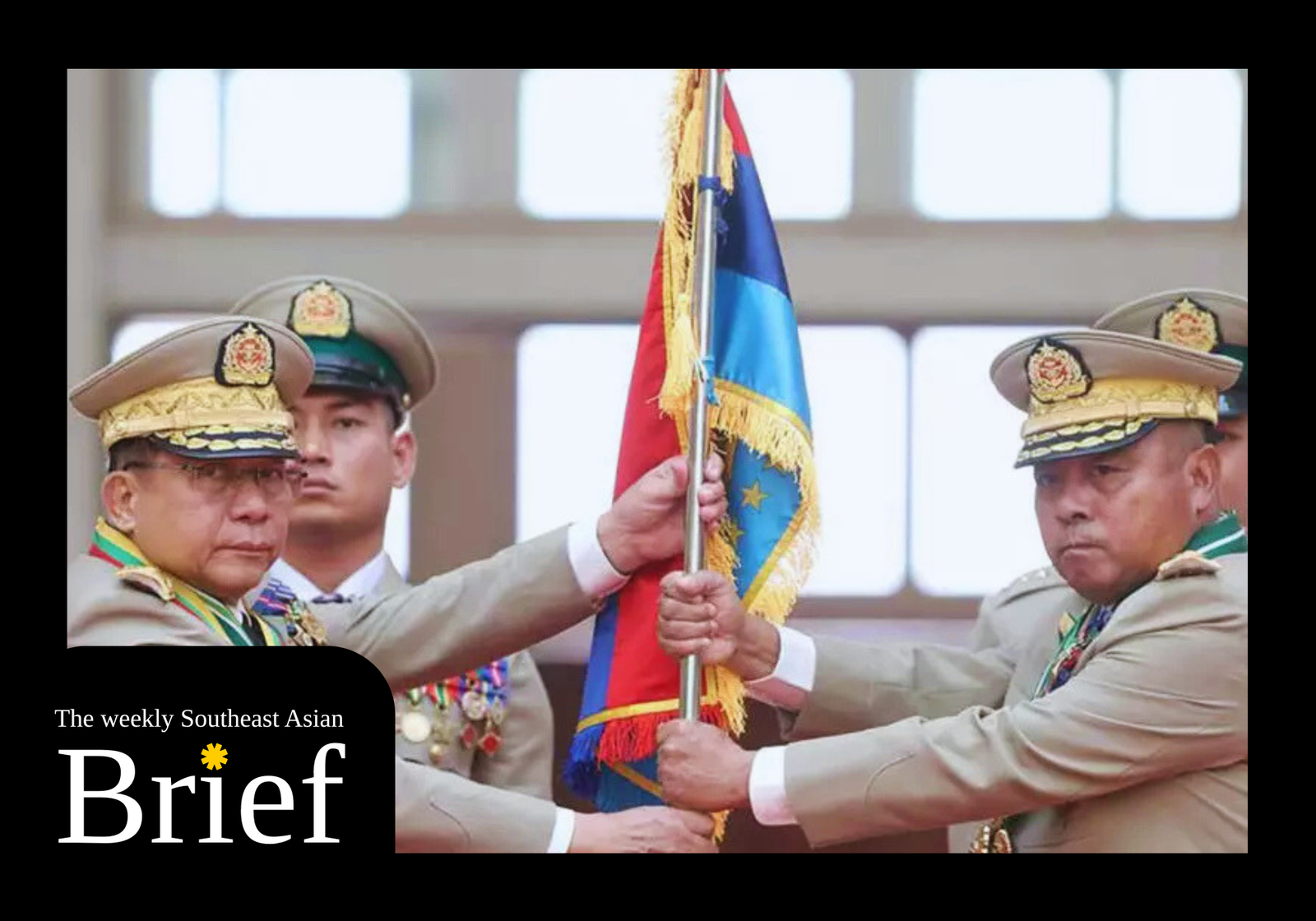
Myanmar’s Senior Gen. Min Aung Hlaing and his successor as military chief Ye Win Oo attend a handover ceremony in Naypyitaw on March 30, 2026. (Myanmar government)
Myanmar’s newly-elected parliament initiated the selection of a new state president on March 30, marking the first such process since the military junta took over power in the 2021 coup. Formally, the procedure follows their constitutional framework: three candidates are nominated by different parliamentary blocs, after which one is elected president while the remaining two assume vice-presidential roles.
However, the nominees were drawn largely from military-aligned circles, particularly figures associated with the pro-junta Union Solidarity and Development Party (USDP), who won the most votes in the January elections. Among those put forward were junta leader Min Aung Hlaing, alongside other pro-military figures such as Nyo Saw and Nan Ni Ni Aye.
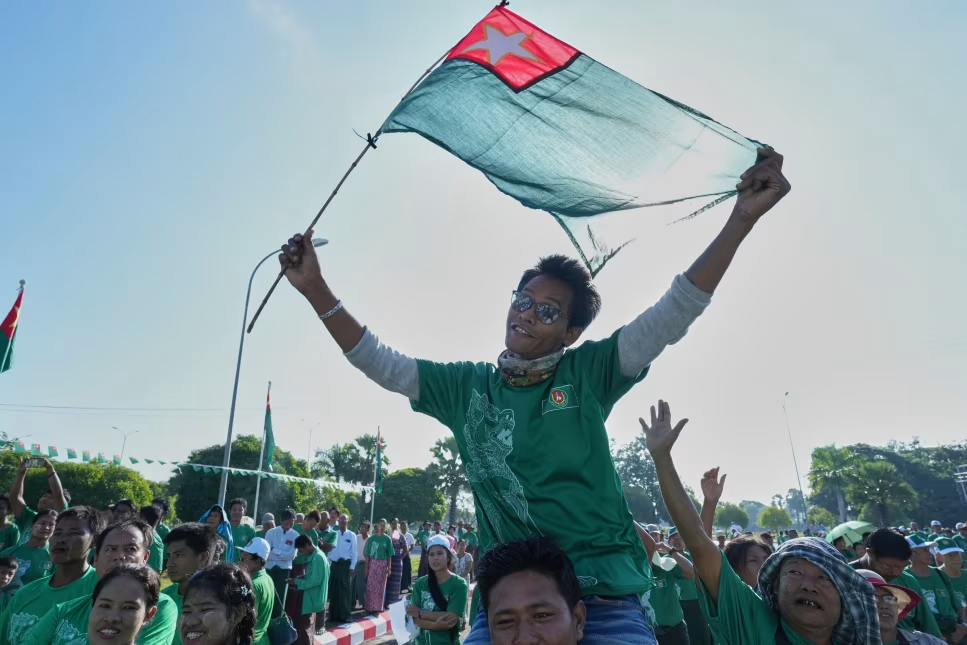
This lack of diversity is further reinforced by the broader electoral context. The general election preceding the presidential selection was conducted in three phases and concluded in late December, yet it took place under conditions of ongoing civil conflict, widespread repression, and the exclusion of major opposition groups. As a result, the electoral outcome heavily favoured military-backed actors. It could be speculated that this current final vote only consolidates this trajectory, as Min Aung Hlaing secured the presidency with 247 out of 260 parliamentary votes, which is an overwhelming margin suggests a highly controlled political environment in which outcomes are largely predetermined, not naturally competitive.
The military’s role in Myanmar is not new, as it has long been embedded within the political system and often positions itself above civilian authority. In the eyes of the international community, it has increasingly become associated with systematic violence, mass killings, and the restriction of basic rights, which resulted in a crisis that is not only immediate but also deeply structural, affecting civilians across the country through indiscriminate violence and limited access to humanitarian assistance.
Consequently, since the 2021 coup, the country has been marked by prolonged instability, where displacement has reached over 3.6 millions, civilian casualties continue to rise from 6000, and resistance movements such as the 2021 Spring Revolution persist despite heavy repression.
Against this backdrop, the transition appears less as a shift in governance and more as a strategic recalibration of power. While institutional procedures are maintained, they operate within a constrained political field shaped by military dominance, only adjusting the “form” from junta leadership to a formal presidential role. This raises a broader question about the nature of political change in Myanmar. If the actors, structures, and outcomes remain largely consistent, then the transition may not represent a break from the past, but a continuation through different institutional forms.
There are, however, emerging dynamics that complicate this picture. In response to continued military rule, anti-junta groups have begun consolidating their efforts through initiatives such as the Steering Council for the Emergence of a Federal Democratic Union (SCEF), which aims to coordinate political, military, and administrative strategies among opposition forces seeking to dismantle the junta in Naypyidaw. While this development signals a growing articulation of a federal and potentially more inclusive political vision, including toward marginalised groups such as the Rohingyas, its impact remains limited by ongoing conflict, fragmented territorial control, and the continued dominance of the military. As such, the prospect of inclusion appears not only uncertain, but also contingent on forces operating largely outside the current state structure.
Regionally, the situation also presents challenges. ASEAN has expressed concern over the credibility of Myanmar’s political process, but its response continues to be shaped by the principle of non-interference. While the crisis has clear cross-border implications, particularly in the form of Rohingya displacement, collective action remains limited. In the end, the March 30 transition does not resolve the question of inclusion, but it highlights a deeper tension between political form and political reality as the appearance of change is present but the structures that have historically produced exclusion remain largely in place. For the Rohingya, this suggests that their condition is not simply tied to who holds power, but to enduring structures that continue to reproduce exclusion even as political arrangements appear to change.
About The Author