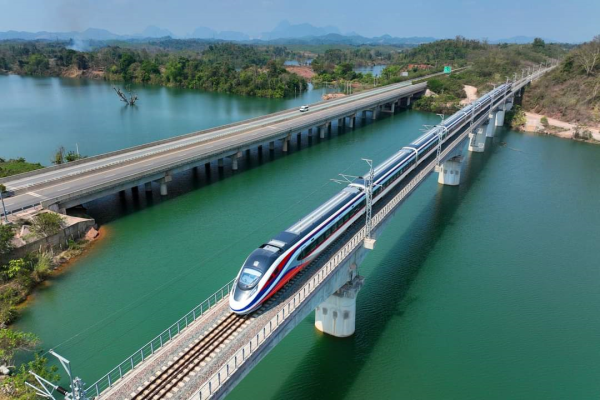
The Lao-China Railway, one of the flagship projects of Beijing’s Belt and Road Initiative (BRI). (KPL)
Laos has continued to deepen ties with its long-standing partner China while promoting its investment potential in an attempt to realise its National Socio-Economic Development Plan 2026-2030.
The assertion was made clear by the Standing Deputy Prime Minister and Head of the Lao delegation, Saleumxay Kommasith, during the 11th Hong Kong Belt and Road Summit on September 9.
Under the theme “Advancing High-Quality Development: Embarking on A New Journey”, Saleumxay remarked that Laos welcomed the high-quality development focus, noting that such an approach would accommodate the country’s endeavour to embark on digital transformation and strengthen its supply chain.
Crucially, he called for Belt and Road Initiative (BRI) partners to boost investment for “critical economic and regional infrastructure development,” highlighting the significant impact the programme has generated in turning Laos from “a landlocked country into a land-linked one”. The flagship project, the China-Laos railway, has reportedly curbed travel time and the cost of the country’s trade movement.
In particular, Saleumxay promoted Laos’ priority development sectors, namely agriculture, tourism, high-end industry, digital connectivity, green energy and human resource development.
These efforts closely align with Laos’ 10th National Socio-Economic Development Plan 2026-2030, through which the government aims to register major breakthroughs in turning the nation into a regional logistics hub and, most importantly, to graduate from Least Developed Country (LDC) status.
What does this mean for businesses?
Reportedly, in the first seven months of 2026, the Lao government approved 34 projects worth 8.5 billion US dollar. This represents a massive 68% year-on-year increase in concession pacts and controlled activities. While this surge appears promising on paper, the stakes remain exceptionally high. To fully realise its development targets, Laos must first address deep-seated structural issues, chief among which is a skyrocketing debt crisis fuelled by underperforming state-owned enterprises. To prevent worsening its fiscal vulnerability, the government must ensure future foreign capital inflows do not double down on foreign-currency-denominated liabilities. Should these structural risks be settled, this high-quality development framework could provide the vital pathway for the country to escape LDC status through genuine, sustainable economic expansion.
Kala Advisory helps investors navigate complex concession frameworks and mitigate currency risks to build targeted, compliant entry plans across Laos and Southeast Asia. Visit kala-advisory.com.
About The Author