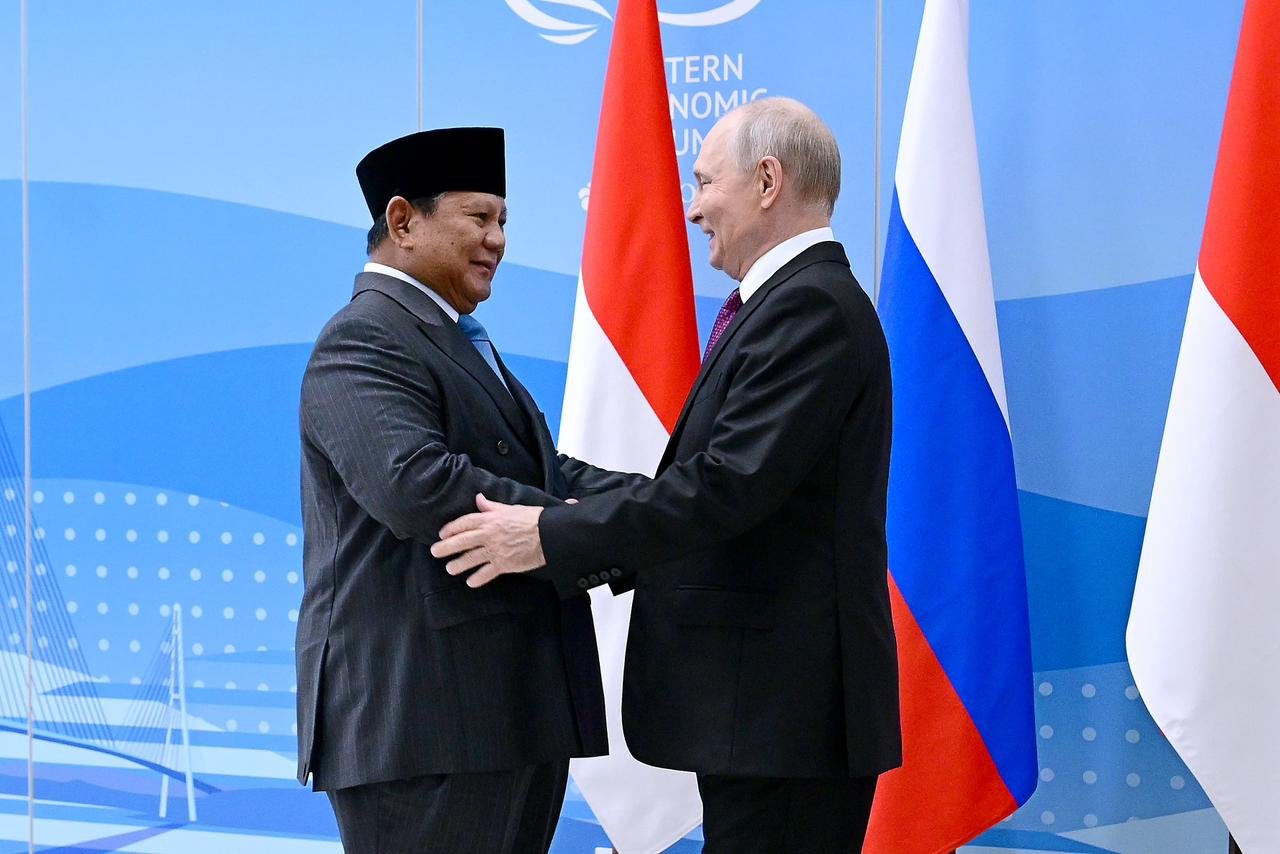
Indonesian President Prabowo Subianto and Russian President Vladimir Putin on the sidelines of the 11th Eastern Economic Forum, on September 3. (BPMI Setpres)
Ahead of the Indonesia-Eurasian Economic Union Free Trade Agreement (I-EAEU FTA) implementation scheduled for 2027, Indonesian President Prabowo Subianto proposed that the two biggest nations of the bloc, Indonesia and Russia, double their trade volume.
The intention was conveyed during his remarks at the 11th Eastern Economic Forum (EEF) in Vladivostok, Russia, on September 3. “I propose that Indonesia and Russia set a clear challenge for ourselves: to double our trade volume during the initial review period of the Indonesia-Eurasian Economic Union Free Trade Agreement,” the president affirmed.
President Prabowo emphasised a substantial increase in bilateral trade, reaching 5 billion US dollar in 2025. Yet, he claimed the achievement is merely the beginning and further urged EAEU member states to swiftly ratify the pact to tap into its full potential.
Crucially, President Prabowo noted that both nations “possess strengths in their respective sectors,” promoting Indonesia’s prominent commodities such as palm oil, coffee, rubber and textiles, fisheries, as well as a massive domestic market and young workforce.
He also mentioned that, “for the Eurasian business community, Indonesia serves as a natural gateway to ASEAN. We are the region’s largest market, a central player in the Regional Comprehensive Economic Partnership (RCEP), and now, a free trade partner”.
What does this mean for businesses?
For commercial entities, this landmark accord serves as an immediate market catalyst by dismantling tariff barriers across thousands of product lines, granting Eurasian companies direct access to 290 million consumers while allowing Indonesian exporters to seamlessly scale up operations. Nevertheless, significant geopolitical risks persist, as firms must navigate Western secondary sanctions targeting trade with Russia, meaning compliance officers and logistics planners will need to heavily rely on the alternative payment mechanisms and dedicated shipping corridors currently being developed by both governments.
Kala Advisory helps investors navigate shifting sanctions landscapes and turn complex cross-border trade accords into targeted, country-by-country market entry plans across Southeast Asia. Visit kala-advisory.com.
About The Author