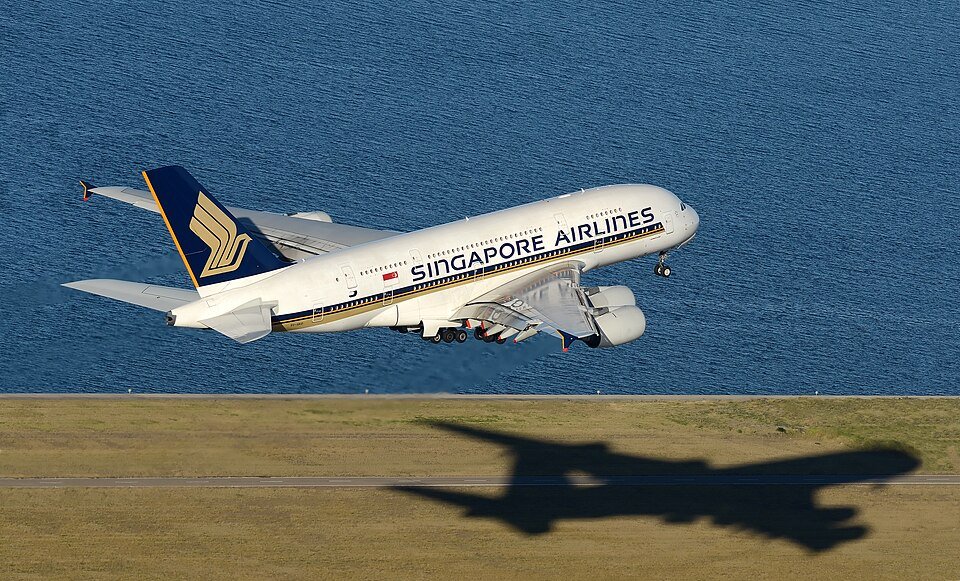
A Singapore Airlines Airbus A380 takes off. (Wikimedia/Damien Aiello)
Singapore’s state investor Temasek on August 29 publicly declared support for the flag carrier Singapore Airlines’ (SIA) investment in Air India. This response, expressed through an official pronouncement, was intended to address heightened concerns over the Indian carrier’s ever-increasing losses.
For context, developments in recent years have substantially triggered operational losses for the Indian airline, including Pakistan’s airspace ban, the Middle East conflict, the Russia-Ukraine war and a depreciating Indian rupee. As of late March, Air India’s combined net loss reportedly accounted for over 2.3 billion US dollar for the financial year.
Consequently, to maintain its turnaround programmes, Air India announced on August 25 that it seeks 1.5 billion US dollar in fresh equity from its co-owners, namely Tata Sons and SIA. Holding a 25.1% stake, SIA was undeniably impacted severely, logging a notable net loss of 76 million Singaporean dollar (60 million US dollar) during April-June this year, marking its first quarterly net deficit since 2022.
In the communiqué, SIA’s majority shareholder explained that it remains confident in the carrier’s discipline and resilience for long-term growth. Temasek’s Head of Ecosystem Enablement Juliet Teo elaborated that “SIA has articulated its objective to invest in a second hub to secure long-term growth beyond Singapore,” and India, as the world’s third largest air transport market after the US and China, is “well-positioned to serve as this second hub”.
She recognised that the “large-scale transformation of Air India involves complex, multi-year operational and integration challenges,” further noting that “efforts of this scale take time and are not expected to be linear, particularly in the aviation sector, where outcomes are shaped by industry developments, including aircraft innovation and fleet renewal cycles, and external factors such as airspace disruptions, geopolitical developments and fuel price volatility”.
What does this mean for businesses?
The stakes are exceptionally high for global firms engaging in cross-border joint ventures. Temasek’s admission that this transformation “will take time” underscores a critical corporate reality: sweeping restructurings of formerly state-owned giants require immense patience and a willingness to absorb painful, non-linear short-term losses. Should Air India turn around and eventually yield a massive profit, SIA’s 25.1% stake could become an incredible cash cow for the carrier. Consequently, the business world is watching closely to see if this is a visionary long-term bet or a classic sunk-cost fallacy. Lastly, it is important to note that Temasek remains non-committal about assisting with the immediate 1.5 billion US dollar funding call, effectively leaving the critical capital allocation decision to SIA’s independent board.
Kala Advisory helps companies navigate complex cross-border joint ventures and build resilient, multi-hub expansion strategies across Southeast Asia. Visit kala-advisory.com.
About The Author