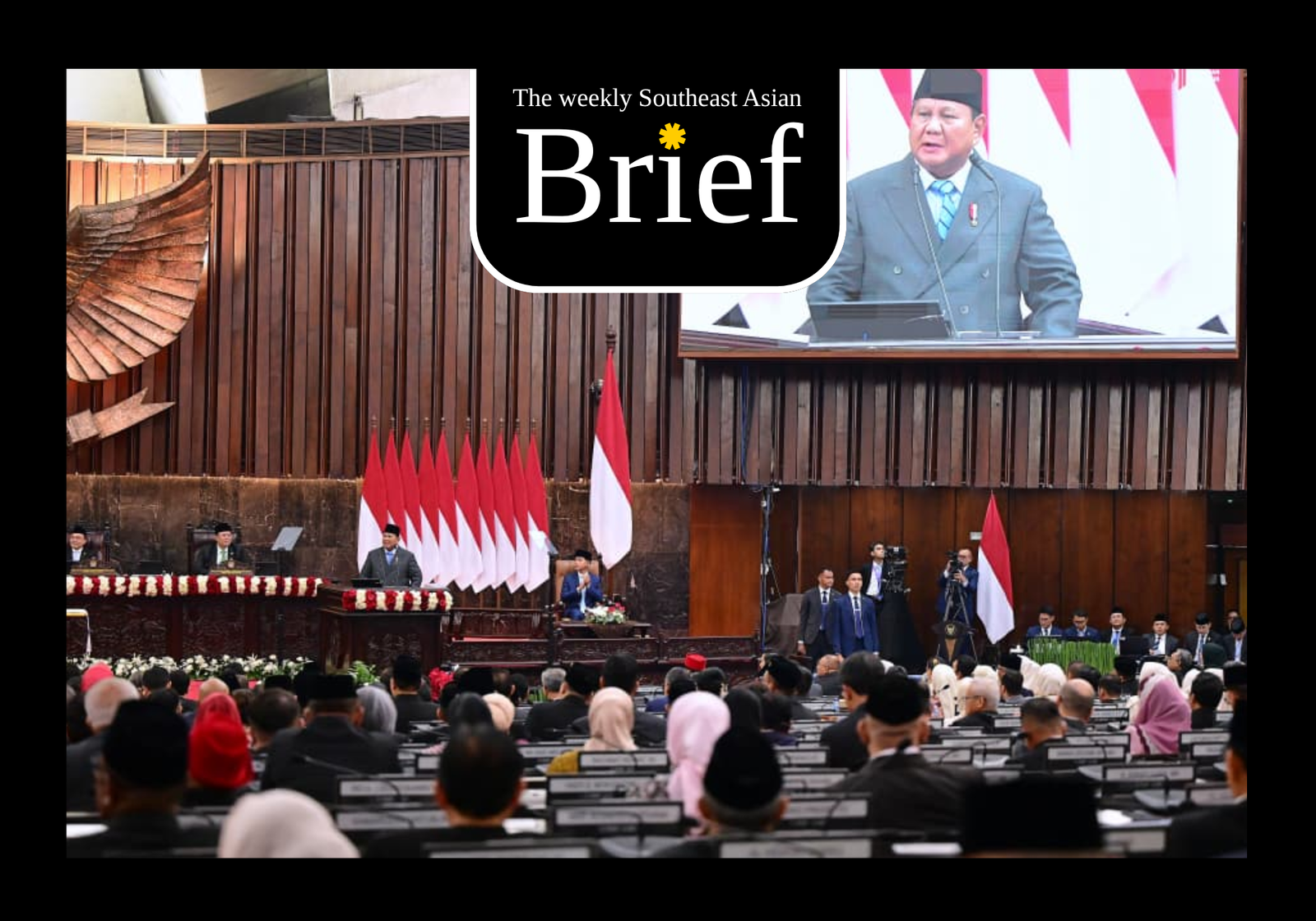
Indonesia’s President Prabowo Subianto gives the State of the Nation address in the House of Representatives in Jakarta on August 14, 2026. (Indonesian Cabinet Secretariat)
On August 14, Indonesia’s President Prabowo Subianto’s 2026 addressed the country through a State of the Nation speech in anticipation of the Independence Day celebration on August 17. The message was simple, that after 21 months in office, his government claimed to be delivering results. He offered a long-list of numbers to support that message: 1,931 trillion Indonesian rupiah (109.7 billion US dollar) in investment, 5.61% economic growth, 121 “transformative” policies, 71,744 renovated schools and tens of millions reached by the flagship Free Nutritious Meals programme.
Taken together, the figures create a picture of the government moving quickly and delivering at a large scale. The numbers are impressive. But numbers alone do not prove that a government has succeeded.
Many of the figures used by Prabowo are based on real government data. The problem is what the government claims those figures prove. Throughout the speech, government activity is often presented as government success. A target is described like a completed result. The number of policies becomes proof of transformation. The number of people reached by a programme becomes proof of its impact. This makes the speech difficult to judge at face value. A statistic can be completely real and still be used to create a misleading impression.
Prabowo’s economic case is the strongest part of the speech and the headline figures are real. Investment Ministry data records 1,931 trillion Indonesian rupiah (109.7 billion US dollar) in realised investment in 2025 and 2.71 million associated jobs and the Central Statistics Agency (BPS) recorded growth of 5.61% in the first quarter and 5.45% in the first half of 2026.
What these figures do not describe is what changed for households and other official data from the same period points in a less favourable direction. BPS recorded a Gini ratio of 0.368 in March 2026, up 0.005 points from September 2025. Inequality had been falling since a 2023 peak of 0.388 before this reversal. Informal work accounted for 59.42% of employment in February 2026, with the number of informal workers rising over the year from 86.58 million to 87.74 million, continuing a decline in the formal share that has run since February 2024. Mandiri Institute estimated that the middle class shrank by 1.2 million people during 2025, from 17.1% to 16.6% of the population.
Poverty did fall over the same period. BPS put the poverty rate at 8.07% in March 2026, down from 8.25% in September 2025. But that is measured against a line of 669,235 Indonesian rupiah (37.82 US dollar) per person per month, a threshold that captures extreme deprivation instead of economic security. Growth also has causes outside government control, including commodity prices, global demand and investment decisions taken before this administration. A growth figure alone does not show that a policy caused the improvement.
Furthermore, the president said that his government had implemented 121 “transformative policies” in 663 days, or about one every five and a half days. The speech does not say what makes a policy transformative or how the 121 were selected, so nobody outside the government can assess the claim. Passing a policy is also not the same as the policy working.
The same problem applies to state-owned enterprises (BUMN). Prabowo said 290 BUMN had been closed, that fewer than 300 would remain by the end of 2026 and that around 50 trillion Indonesian rupiah (2.8 billion US dollar) in overhead costs had been saved. BUMNs operate through parent companies, subsidiaries and affiliates, so removing an entity from the list does not necessarily mean the activity behind it has stopped. He also called the exercise potentially “the largest corporate restructuring in the world” without saying “largest” by what measure, either companies, assets, employees or money saved. As stated, the claim cannot be checked.
Moreover, Prabowo said more than 71,744 schools had been repaired. Government documents describe 71,744 as the 2026 target for school revitalisation, made up of 11,744 education units that had received funding and a further 60,000 planned. A plan to renovate 71,744 schools and 71,744 renovated schools are different statements and the difference matters in a speech presenting a 21-month record.
The flagship Free Nutritious Meals programme works the same way. The National Nutrition Agency reported that around 62.4 million people had been reached through 29,225 service units by 24 May. That measures delivery, not nutrition, stunting or school performance. Repeated mass poisoning cases make the point directly. The scale of a programme says nothing about the quality of what is being delivered.
Seen together, these examples suggest that the issue goes beyond individual misinterpretation as the administration’s political narrative repeatedly moves through the same chain. Investment becomes prosperity, growth becomes welfare, policies become transformation, targets become achievements, and reach becomes impact.
Each step makes the government’s record sound stronger than the original statistic alone would suggest. This does not mean that every figure is fabricated. In fact, the more effective form of political exaggeration is often built on real numbers.
A government does not necessarily need to invent 109.7 billion US dollar in investment. It can simply present that number without discussing what kind of jobs were created or who benefited. It does not need to invent the 71,744-school figure. It can turn a target into a completed achievement.
That makes this kind of political messaging harder to challenge than an outright falsehood. Fact-checking can establish whether the statistic exists. It takes a second level of analysis to establish whether the statistic actually supports the claim being made.
This is unlikely to be the last time the administration uses this approach. Prabowo still has flagship programmes that require political support, including the Free Nutritious Meals project, food self-sufficiency, BUMN restructuring and education revitalisation. As these programmes expand, the government will have a strong incentive to highlight numbers that show their scale: more beneficiaries, more schools, more investment, more policies and more savings. The risk is that these outputs become the main way the programmes are judged.
That would allow the government to build political momentum around programmes before their longer-term results are fully known. It also makes criticism easier to dismiss because questioning the programme can be framed as questioning the progress represented by its numbers.
This pattern can create a growing gap between government-defined success and public experience. The government may point to millions of beneficiaries, trillions of rupiah and thousands of completed or targeted projects, while the populace experiences the results very differently.
As Prabowo moves further into his term, the distinction will become increasingly important. The administration will have more time to show whether its flagship programmes actually deliver the outcomes promised. For now, its strongest evidence remains the scale of what it has done.
And that is precisely where the scrutiny should begin: not with how big the numbers are, but with what they actually prove.
About The Author