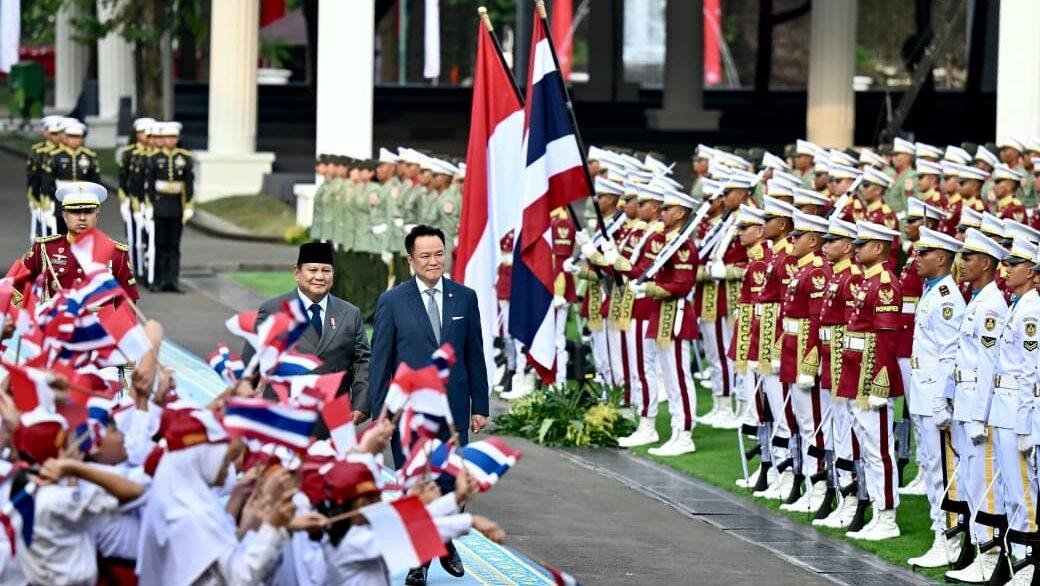
Indonesian President Prabowo Subianto welcomes Thai Prime Minister Anutin Charnvirakul at Merdeka Palace in Jakarta, on August 3, ahead of bilateral meeting. (Cabinet Secretariat of the Republic of Indonesia)
In the subsequent joint press statement, President Prabowo affirmed that “economic cooperation remains a key pillar for Indonesia and Thailand bilateral relationship,” highlighting that both parties have ratified the Indonesia-Thailand Strategic Partnership Roadmap 2026-2030.
“Amid global economic transformation, Indonesia and Thailand are committed to strengthening cooperation in the digital economy sector, including the use of local currency transactions to improve efficiency in trade and investment,” President Prabowo added.
Crucially, both sides placed equal weight in bolstering the digital economy sector, with the Local Currency Transaction (LCT) framework being advanced to curb trade barriers. President Prabowo elaborated that the use of LCR will “improve trade and investment efficiency” by enabling direct transactions using respective local currencies, bypassing US dollar conversions.
Sharing the view, PM Anutin emphasised that “indeed, Thailand and Indonesia have vast potential to expand the volume of bilateral trade and investment,” describing the two countries as “key pillars of ASEAN” well positioned with longstanding relations to nurture a “mutually beneficial partnership”.
What does this mean for businesses?
This landmark summit—marking the first official state visit by a Thai prime minister to Indonesia in 15 years—signals a substantial renewal of high-level political will. For enterprises operating across both borders, the immediate focus on LCT and digital frameworks will directly cut transactional costs, eliminate foreign exchange volatility from third-party currencies (US dollar) and accelerate regulatory clearance. As both countries aim to escape the middle-income trap, this cooperation offers tangible steps forward. Beyond financial integration, collaborative efforts to drive a bilateral energy forum and a coordinated halal industry push are also being rolled out, defining the exact growth sectors businesses should now pursue.
Kala Advisory helps investors turn local currency frameworks and regulatory shifts like these into targeted, country-by-country entry plans across Southeast Asia. Visit kala-advisory.com.
About The Author