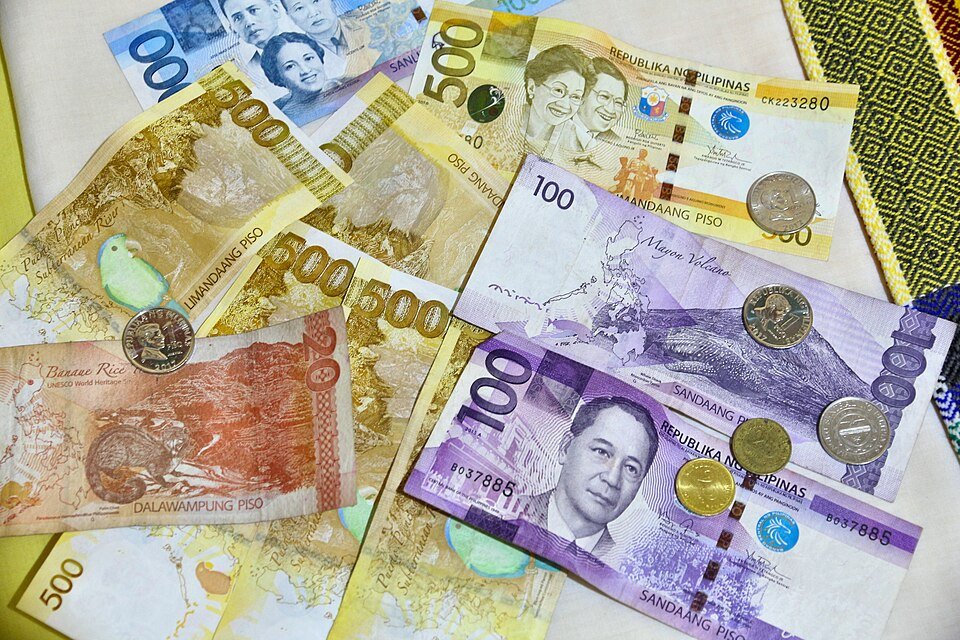
The Philippine peso. (Wikimedia/Marek Ślusarczyk)
This surge was underpinned by market turnover reaching 895.28 million shares valued at 6.5 billion Philippine peso (105.8 million US dollar). The majority of the sectoral indices advanced, with Financials leading the gains via a 1.85% jump. Holding Firms followed with a 1.69% increase, while Industrial, Property and Mining & Oil rose by 1.18%, 1.07% and 0.66%, respectively. Services was the lone decliner, dropping 1.72%.
Despite local economic optimism (spurred by the World Bank recently upgrading the Philippines to upper-middle-income status) the Philippine peso succumbed to general US dollar strength. The local currency lost 7.6 centavos from its previous close of 61.415, snapping a brief two-day recovery streak.
The chief economist further explained that the robust PSEi’s performance was driven by an expected decline in the domestic inflation rate from 6.8% recorded last month. Broadly, he attributed this shift to mounting market confidence following the easing of geopolitical tensions in the Middle East.
What does this mean for businesses?
This macroeconomic divergence presents a split environment for businesses. The combination of cooling inflation and lower domestic pump prices offers immediate relief to corporate supply chains and local logistics networks, while a robust equities market lowers capital-raising costs for listed firms. However, import-dependent firms and enterprises servicing US dollar-denominated debts face severe margin compression due to the depreciating peso. Ultimately, this climate favours operations that leverage local sourcing over international trade.
Kala Advisory helps investors read shifts like these, from currency swings to inflation trends, before committing capital in Southeast Asia. Visit kala-advisory.com.
About The Author