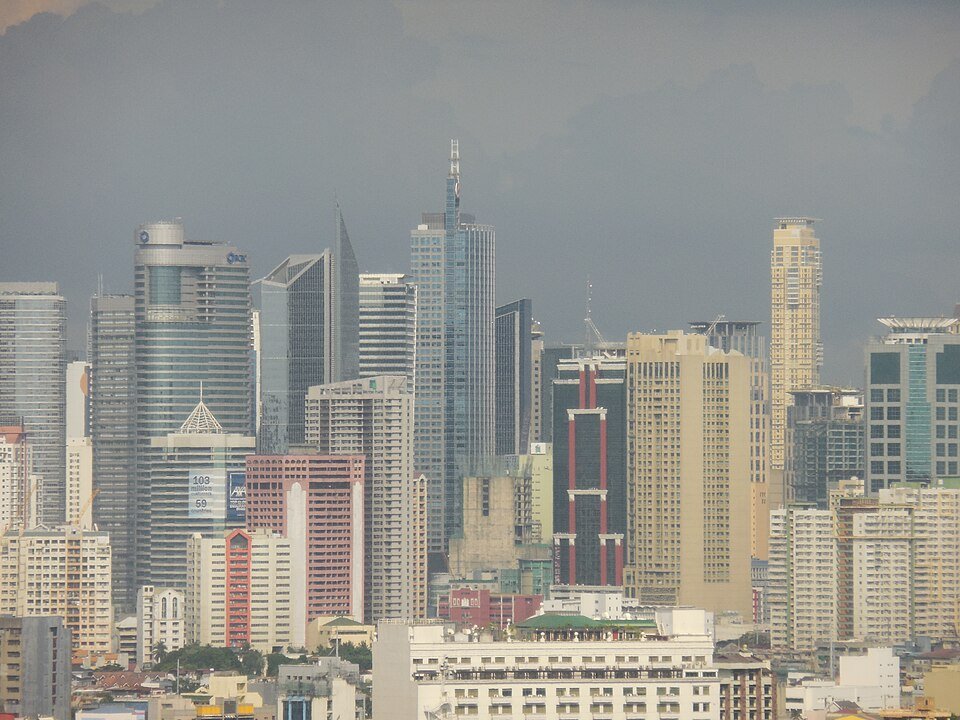
Makati central business district, Philippines. (Wikimedia/Lawrence Ruiz)
The World Bank disclosed that the Philippines’ gross national income (GNI) per capita stood at 4,850 US dollar, surpassing the 4,636 US dollar threshold required for UMIC status.
The World Bank explained in a separate commentary that “the Philippines achieved its reclassification through broad-based expansion. Gross Domestic Product (GDP) grew at an average of 5.8% per year over five years, reflecting gains across all major industries, not a single sector boom, but an economy-wide shift”.
Manila welcomed this upgrade through its Department of Economy, Planning and Development (DEPDev), elaborating that steady growth, sound macroeconomic policies and deep structural reforms propelled the country to UMIC status.
“This confirms the resilience of the Philippine economy. Despite global and domestic shocks, we have relentlessly pursued inclusive growth, strengthened fundamentals and remained on track with our development agenda,” DEPDev Secretary Arsenio Balisacan noted. He emphasised Manila’s commitment to “deepen reforms” to sustain their economic trajectory.
Secretary Balisacan also credited overseas Filipino workers (OFWs), noting that their foreign earnings are vital components of the nation’s GNI.
Concluding his remarks, he reminded that an economic step-up does not erase current challenges. He affirmed that the government’s priority is to “ensure that growth becomes more inclusive, and that its benefits reach all Filipinos”.
Along with the Philippines, Jordan, Micronesia, Sri Lanka and fellow ASEAN state Vietnam also moved from the low-middle-income to upper-middle-income tier.
This elevation marks a significant departure from the lower-middle-income bracket the Philippines had been stuck in since 1987.
What does this mean for businesses?
Transitioning away from lower-middle-income status will gradually reduce the country’s access to highly subsidised Official Development Assistance (ODA) and low-interest foreign grants. To bridge this funding gap for critical infrastructure, Manila is highly likely to pivot towards private capital markets and aggressive Public-Private Partnerships (PPPs), opening up massive commercial pipelines for local and international contractors who can now bid on large-scale national utility and logistics projects.
Simultaneously, this economic elevation acts as a financial umbrella, drastically improving the nation’s sovereign credit profile and unlocking trillions of dollars from global institutional funds restricted to higher-tier markets. With lower international borrowing costs and minimised risk premiums, Philippine enterprises can access cheaper commercial capital to scale up operations, driving a transition away from low-margin assembly jobs into sophisticated, high-value sectors that expand the local consumer class.
Kala Advisory helps investors move on openings like these, from PPP pipelines to large-scale infrastructure, across Southeast Asia. Visit kala-advisory.com.
About The Author