
Indonesia’s Nutri-Level labeling initiative was introduced on April 14, 2026 as part of broader public-health policy efforts. (Indonesian Ministry of Health)
Ika Puspa is a communications strategist from Indonesia. The views expressed are her own and do not represent SEA Daily or that of another organisation.
The Growing Importance of Policy Signaling
Across Southeast Asia, governments today are not short of policy ambition. New industrial strategies, investment reforms, digital economy roadmaps and public health interventions continue to emerge across the region. On paper, many of these policies are technically sound and strategically necessary. Yet increasingly, the effectiveness of policy is shaped not only by substance, but by how it is communicated, interpreted, sequenced—and experienced—by the public and the market.
In many cases, uncertainty no longer comes from the absence of policy, but from inconsistent signals surrounding it.
This is becoming one of the defining governance challenges in Southeast Asia: the gap between policy intention and policy perception—a concern increasingly reflected in regional governance and digital-policy initiatives such as the ASEAN Digital Masterplan 2025.
Across Southeast Asia, this challenge is becoming increasingly visible as governments introduce policies designed not only to regulate markets, but also to shape public behavior. From sustainability regulations to digital governance frameworks and public-health interventions, policy implementation now depends heavily on how direction, timing and institutional coordination are communicated to the public and the market.
In contrast, uncertainty tends to emerge when policy communication becomes fragmented across institutions, timelines shift without coherent explanation or implementation signals appear inconsistent with official narratives.
This is why communication today can no longer be treated merely as a supporting function of governance. Communication has become part of governance itself—not merely a supporting instrument.
Indonesia’s Nutri-Level Debate and the Politics of Signaling
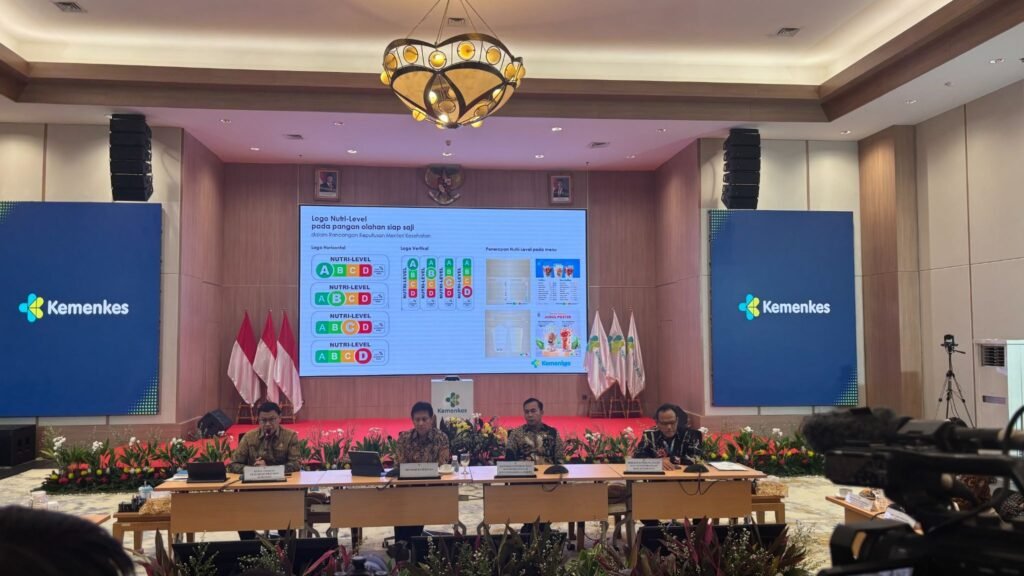
Indonesia’s Nutri-Level labeling initiative was introduced on April 14, 2026 as part of broader public-health policy efforts. (Photo: Ministry of Health)
One recent example illustrating this dynamic is the emerging Nutri-Level policy in Indonesia’s food and beverage sector, launched on April 14, 2026 as part of broader efforts to address rising non-communicable diseases (NCDs) and improve public-health outcomes. At its core, the policy aims to encourage healthier consumption patterns through a simplified nutrition labeling system using color-coded categories based on sugar, salt and fat content. The broader objective is understandable. According to data highlighted by Indonesia’s Food and Drug Monitoring Agency (BPOM), approximately 73% of deaths in Indonesia are linked to non-communicable diseases, including complications related to diabetes and hypertension.
However, what makes the Indonesian case particularly interesting is not merely the substance of the policy, but the signaling ecosystem surrounding it.
The policy currently remains voluntary during its transition phase, although the government has already signaled that mandatory implementation may eventually follow. At the same time, discussions surrounding the policy have expanded beyond nutrition labeling itself, evolving into broader debates about sugar taxation proposals, future advertising restrictions and the broader direction of public-health regulation in Indonesia. As public debate surrounding the policy continues evolving during the drafting process, stakeholder responses may also influence how the framework is ultimately refined, sequenced and communicated by regulators. In this sense, communication surrounding the policy is no longer merely reactive —it may gradually become part of the policy making itself.
In practice, the policy discussion has already triggered broader conversations within the food and beverage industry regarding reformulation strategies, packaging adjustments and future compliance planning. Businesses and regulators are already discussing how companies need to reformulate products, redesigning packaging, adjust nutritional disclosures and prepare for possible future mandatory implementation requirements as the Nutri-Level framework gradually expands.
Several industry groups and food manufacturers have also begun discussing long-term investment considerations and potential implications of future mandatory implementation. Concerns surrounding possible sugar-related fiscal measures and future advertising restrictions have increasingly become part of the broader market interpretation surrounding the policy.
At the same time, public-health advocacy groups continue encouraging regulators to strengthen implementation beyond voluntary labeling alone with stronger fiscal policy. Critics argued that voluntary implementation may be insufficient to significantly influence consumer behavior without stronger regulatory interventions.
As regulators continue balancing public-health priorities, economic considerations and implementation feasibility, evolving stakeholder responses could influence how the framework is ultimately refined, sequenced and communicated.
This reflects a broader challenge in policy communication. Even when a policy remains voluntary during its transition phase, surrounding narratives and evolving public discussions can shape market expectations well before implementation becomes mandatory. In this context, communication does not merely explain policy. It actively shapes how the market interprets regulatory direction.
What is equally notable is that the policy itself remains in an active process of institutional harmonisation. Discussions continue between ministries, regulators, public health advocates, and industry stakeholders. The broader regulatory framework also continues to evolve, including questions surrounding implementation pathways and stakeholder engagement.
This creates a condition increasingly common in modern governance: policies are often interpreted by the market before they are fully finalised.
Public debate surrounding the Nutri-Level policy is, in many ways, a normal feature of democratic policymaking. Public-health advocates, regulators, industry players and consumers naturally interpret policies through different priorities and concerns. Some public-health advocates criticise the government for being too soft on industry interests and argue that voluntary labeling is insufficient to change consumer behavior. Others within industry circles remain concerned that the labeling system may become the first step toward broader fiscal and regulatory interventions in the future.
The challenge emerges when institutional signaling becomes difficult to interpret consistently across the broader policy environment. In such situations, uncertainty is shaped not merely by the existence of debate itself, but by how clearly governments communicate regulatory direction, implementation sequencing and long-term policy objectives. Meanwhile, regulators themselves appear to be balancing public-health objectives, economic considerations, implementation readiness and political feasibility simultaneously.
The result is not necessarily direct opposition to the policy. Rather, it is interpretive uncertainty, where stakeholders begin responding not only to current regulations, but also to assumptions about where future policy direction may eventually lead.
Why Governance Credibility Depends on Communication
And this matters because modern economies increasingly operate on expectations as much as regulations.
Businesses make investment decisions based not only on what governments formally announce today, but also on what they believe governments are likely to do next. Consumers respond not only to rules, but to narratives as well. Markets assess not only policy design, but also institutional coherence—whether governments appear aligned, predictable and credible over time.
The Nutri-Level debate illustrates how modern policymaking is no longer interpreted solely through formal regulations, but also through signals surrounding future direction, implementation timing and institutional coordination. This is particularly important in Southeast Asia, where governments are simultaneously pursuing growth, investment competitiveness and ambitious social and public-health agendas. The challenge is not simply designing good policy, but maintaining coherence across institutions, messaging, implementation and stakeholder engagement.
In this environment, governance credibility is shaped incrementally through signals.
A policy may be economically rational and socially beneficial, but if communication appears inconsistent, reactive, or fragmented, uncertainty can still expand. Conversely, even difficult policies often become more manageable when governments communicate direction clearly, sequence implementation carefully, and maintain institutional consistency over time.
This is why communication should not be viewed merely as public relations attached to policymaking. Communication itself has become a strategic policy instrument.
In many parts of Southeast Asia, policymakers are increasingly experimenting with regulatory approaches designed to gradually influence public behavior, market adaptation and long-term social outcomes. Public-health interventions, sustainability agendas, digital regulations and climate-related policies increasingly depend not only on regulation itself, but also on institutional credibility and communication coherence. This broader regional shift is also reflected in initiatives such as the ASEAN Digital Masterplan 2025, which emphasises trusted digital governance, consumer trust and coordinated regulatory frameworks across ASEAN member states.
In such a landscape, the success of policy will depend not only on regulatory substance, but also on whether governments can build credibility through coherent signals, predictable implementation, and institutional alignment.
Because today, policy is no longer judged only by what governments decide. It is judged by how consistently those decisions are communicated, interpreted, and carried through across institutions and over time.
Policy, in that sense, is never just about substance.
It is also about signals.
About The Author