
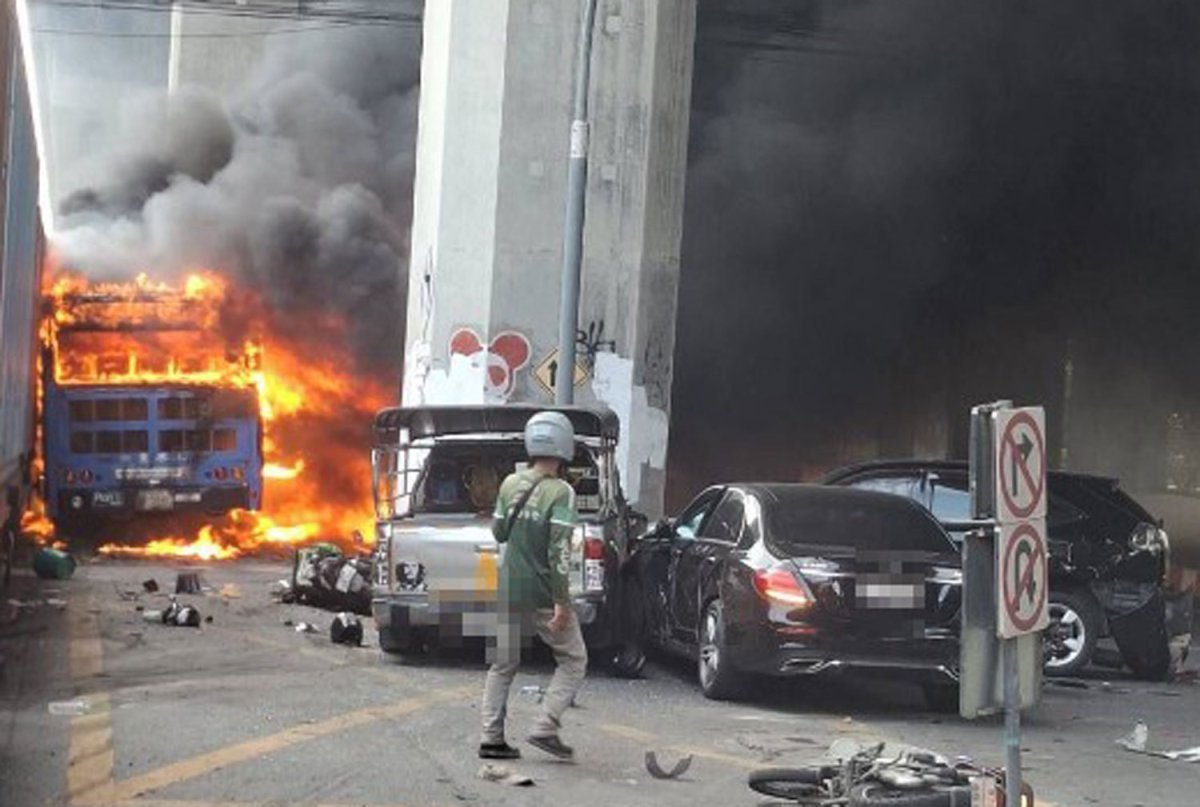
Flames rise from a passenger bus following a collision with a freight train near the Makkasan Airport Rail Link station in Huai Khwang, Bangkok on May 16, 2026. (FM91 Trafficpro)
On May 18, Thai revealed that the driver of a freight train involved in a fatal collision in Bangkok had tested positive for drug use and allegedly did not hold a valid railway operating licence.
The information was disclosed online by Pichet Kunadhamraks, director-general of the Department of Rail Transport. Citing police findings, he stated that the train operator, identified as Sayomporn Suankul, underwent a urine test after the accident which indicated drug use. Sayomporn had been driving freight train number 2126, which was travelling from Laem Chabang to Bang Sue at the time of the incident.
The crash occurred on May 16 at the Asoke–Din Daeng railway crossing, one of Bangkok’s busiest transport hubs. Preliminary reports indicate that a public bus had come to a halt directly on the tracks after becoming trapped in heavy traffic. Because the crossing gate is manually operated, the barrier could not be lowered in time to stop approaching vehicles. The freight train subsequently struck the stationary bus with significant force. The impact triggered a fire that quickly engulfed the vehicle. Officials confirmed that eight people lost their lives in the blaze, while dozens more were injured and taken to hospital.
Police launched an investigation and charged both the bus driver and the railway guard responsible for operating the crossing barrier. In response to the tragedy, transport authorities have ordered stricter safety measures across the railway system. According to Pichet Kunadhamraks, all railway personnel, including train drivers, will now be required to undergo compulsory drug and alcohol screening before starting their shifts.
The Asoke–Din Daeng railway crossing is widely known for its intense traffic congestion. Dr Amorn Phimarnmas, president of the Structural Engineers Association of Thailand, estimates that more than 100,000 vehicles pass through the intersection each day, exceeding the recommended safety capacity for a level crossing. Notably, this incident was Thailand’s second major railway-related accident with a falling crane above a railway causing 32 deaths and dozens of injuries in Nathon Ratchasima last January.
About The Author


One thought on “Bangkok train driver tests positive for drugs after fatal collision”