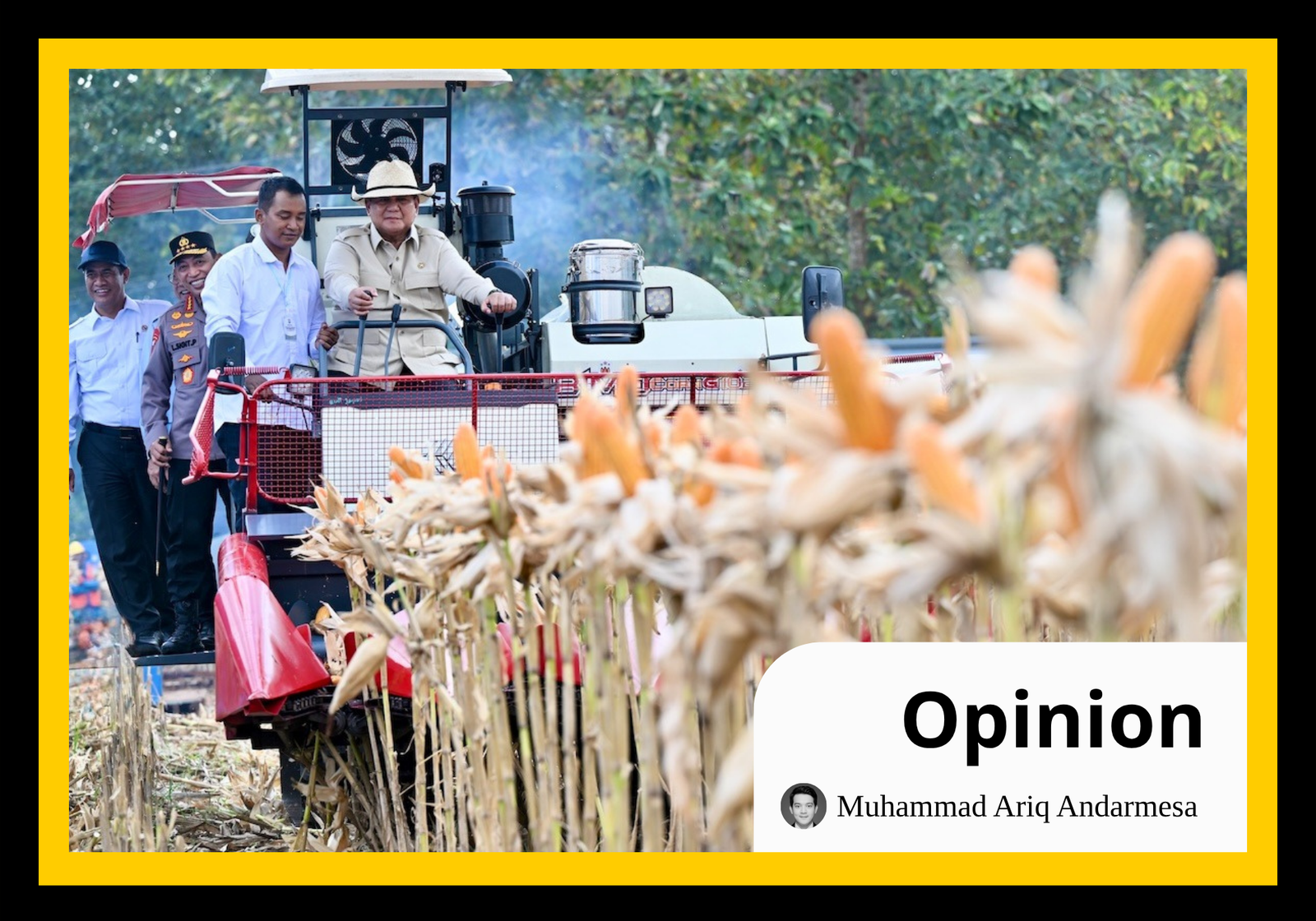
Indonesian President Prabowo Subianto led the Q2 2026 Simultaneous Grand Corn Harvest event held in East Java, Indonesia, on May 16, 2026. (Indonesian Presidential Secretariat)
Muhammad Ariq Andarmesa is a Political Science graduate of Padjadjaran University in Indonesia and writes on Indonesian industrial policy and political economy. The views expressed are his own and do not represent SEA Daily or that of another organisation.
On May 16, 2026, Indonesian President Prabowo Subianto responded to concerns over the weakening rupiah with a seemingly simple remark: “People in the villages don’t use dollars, do they?” He also assured the public that food and energy supplies were secure. At the time, media reports indicated that the rupiah was trading at around Rp17,600 per US dollar. The statement may have been intended to calm public anxiety. In moments of currency pressure, rising global oil prices and market uncertainty, a leader has a responsibility to maintain confidence. Yet there is a clear difference between reassurance and oversimplification.
Taken literally, the president was right. Farmers in Nganjuk, fishermen in Indramayu, small traders in Banyumas, and farm workers in Lombok do not transact in US dollars. They buy rice, pay transportation costs, purchase fertiliser, pay wages and send their children to school in rupiah. But an economy does not operate only in literal terms. In an open economy, the exchange rate moves through the entire production chain. It enters daily life through fuel, LPG, fertiliser, pesticides, animal feed, medicines, agricultural machinery, industrial components and logistics costs. When the rupiah weakens, it changes the cost structure of everyday life.
This is the central flaw in the argument that “villages do not use dollars.” Villages may not use dollars directly, but rural life depends on goods whose production costs are shaped by the dollar. The Indonesian Statistics Agency recorded that in 2025, Indonesia’s total imports reached around 241.86 billion US dollar, of which raw and auxiliary materials amounted to 169.30 billion US dollar, or roughly 70% of the total import. Most imports are inputs for industry, agriculture, energy, and daily economic activity. Agriculture offers the clearest example. In March 2026, APROPI, the Indonesian Crop Protection Association, reportedly warned of a potential 20-30% increase in pesticide prices due to shortages of active ingredients, geopolitical tensions, rising production costs and the weakening rupiah.
For farmers, this creates a practical dilemma: buy more expensive pesticides, reduce usage and risk lower yields, or absorb losses because the selling price of unhusked rice does not always rise as quickly as production costs. Farmers do not need to hold dollars to be affected by the dollar. By purchasing inputs connected to import-dependent supply chains, they already bear the consequences of exchange rate depreciation. The same logic applies to energy. When oil prices rise and the rupiah weakens, energy import costs increase, subsidies become heavier, logistics costs rise, and inflationary pressure follows. In the end, the burden is felt by ordinary households through higher prices and the rising cost of daily living. The real question, therefore, is not whether rural people use dollars, but whether Indonesia’s economic structure is strong enough to protect rural communities from prices shaped by the dollar.
The narrative that rural communities “do not use dollars” risks romanticising poverty. It implies, even if unintentionally, that because rural people live more simply, they are more insulated from global shocks. In reality, low-income households are often the least protected. Inflation forces them to reduce protein intake, postponing non-urgent spending , or buy on credit at local stalls. When food, energy, and production input prices rise, they cannot hedge. They cut consumption. The Indonesian Statistics Agency recorded that as of March 2025, the rural poverty rate stood at 11.03%, far higher than the urban poverty rate of 6.73%. Nationally, 23.85 million Indonesians still lived in poverty. These figures show that rural communities have thinner buffers and fewer tools to protect themselves.
The weakening rupiah should therefore be read as a signal of a deeper structural problem: Indonesia is not yet productive enough, not yet complex enough, and not sufficiently self-reliant in securing its supply chains. Indonesia’s Central Bank reported that the current account recorded a deficit of 2.5 billion US dollar, or 0.7% of GDP, in the fourth quarter of 2025, after a surplus of 4 billion US dollar in the previous quarter. The oil and gas trade deficit also widened as domestic economic activity strengthened. This shows that when the economy grows and energy demand rises, Indonesia still relies heavily on imports.
With such a structure, the rupiah will remain vulnerable. Indonesia still exports too many commodities and imports too many higher-value inputs. It sells coal, palm oil, nickel and other raw or semi-processed materials, while depending on imported energy, chemicals, machinery, components and technology. A strong currency in the long run comes from an economy that produces more high-value goods, builds stronger supplier networks, develops technology, and sells more sophisticated products to the world.
This is also how Indonesia should view the Free Nutritious Meals programme, or MBG, as it is known in Indonesian. Its objectives are noble: improving nutrition, reducing stunting, helping poor families and strengthening human capital. But MBG will become problematic if it remains a massive consumption program disconnected from the national production agenda. As of March 11, 2026, spending realisation for the programme had reached 44 trillion Indonesian rupiah (2.5 billion US dollar) and covered 61.62 million recipients. A programme of this scale must not be treated only as social spending, nor should it become a feeding ground for rent seekers. It should become an instrument for building the national food supply chain. If MBG purchases food from fragile supply chains, depends on imports and fails to strengthen local farmers, it will only increase demand without improving supply. Prices may rise, imports may increase and the fiscal burden may grow. But if MBG is designed as a food industrial policy, it can create guaranteed demand for farmers, livestock producers, fishermen, cooperatives, food-processing MSMEs, cold storage providers, village logistics networks, and local food industries.
These questions matter because the rupiah, rural poverty, imported inputs, and MBG are connected by one major issue: whether Indonesia is building a productive economy or merely managing consumption. Fiscal policy must become an instrument for expanding production capacity, reducing import dependence and increasing economic complexity. Indonesia, therefore, needs a serious reindustrialisation agenda. The state must map the strategic inputs most vulnerable to rupiah depreciation, including energy, fertiliser, pesticides, food commodities, medicines, machinery components and industrial raw materials. It must pursue selective import substitution—not blind protectionism, but domestic capacity in sectors that determine food, energy, health, agriculture and basic industry. The flagship resource downstreaming policy must go beyond nickel into batteries, electric vehicle components, chemicals, pharmaceuticals, medical devices, agricultural machinery, processed food, semiconductors, and defence technology. Every rupiah of public spending must be tested against one question: does it merely relieve symptoms, or does it address the root cause?
For President Prabowo, the issue is not whether villages use dollars. The more important questions are: how dependent are our agricultural inputs on imports? How can MBG strengthen local farmers instead of increasing food imports? How can Indonesia build high-value exports so the rupiah is supported by productive capacity, not only by monetary intervention?
Rural Indonesians do not use dollars. But their fertiliser can be affected by the dollar. Their pesticides, logistics costs, energy prices, and future job opportunities can also be shaped by the dollar. As long as Indonesia has not built industrial self-reliance, strengthened domestic supply chains, expanded high-value exports, and turned public spending into productive capacity, every depreciation of the rupiah will fall hardest on those with the least bargaining power.
About The Author