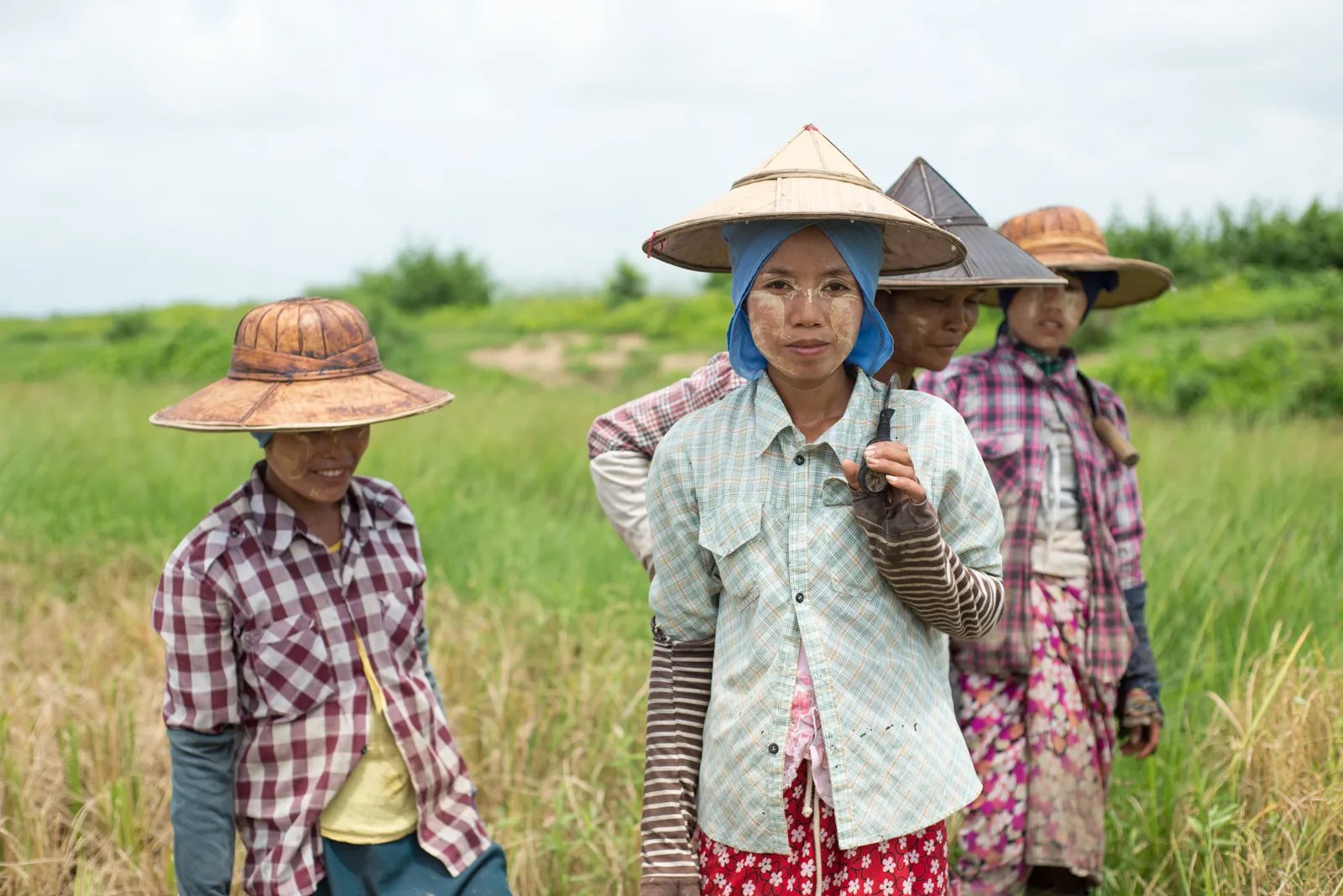
Women farmers tend to their crops in rural Myanmar. (UNDP Myanmar)
China’s agribusiness firm Guokee Bio-Tech Company is slated to partner with Myanmar entrepreneurs to advance joint ventures and establish a business-to-business (B2B) pact in the agricultural sector.
Operating in Yunnan Province, Guokee specialises in agricultural trade and cross-border food supply chains across the Asia-Pacific region. On May 6, according to reports by Lian Siang Mung, Myanmar’s Commercial Attaché in Kunming, the firm expressed interest in procuring dried ginger and konjac powder from Myanmar’s farmers—the former to be exported to Japan, the latter for South Korea.
Lian Siang Mung viewed the overture as an opportunity for local enterprises to “receive better incentives when exporting,” as Guokee is expected to furnish technical assistance through training and technology transfers.
Adding to this, Guokee is set to sign a B2B Memorandum of Understanding (MoU) with Myanmar’s Department of Agriculture and Department of Agricultural Research, aiming to ramp up rice exports from Myanmar to China. The move follows the newly adopted Export to China policy—a regional drive from Yunnan’s Provincial Department of Commerce to rebalance trade in line with a national directive encouraging imports to meet domestic consumption needs.
Under the MoU, Guokee will supply high-quality agricultural seeds—including rice, corn and pedigree varieties—for Myanmar’s farmers to cultivate, with the harvests subsequently exported to China.
What does this mean for businesses?
For Myanmar’s agricultural sector, the partnership offers a tangible entry point into established regional supply chains. The B2B structure allows local enterprises to engage Chinese buyers more directly—bypassing the complexities of government-to-government frameworks and potentially unlocking faster commercial cycles and more competitive export terms.
Beyond market access, Guokee’s pledged technical assistance and training could meaningfully lift the operational standards of smallholder farmers and agribusinesses alike, with benefits that extend well beyond this single partnership.
Realising these gains, however, will hinge on active government commitment—not merely endorsement, but hands-on facilitation to ensure training programmes reach farmers on the ground and seed supply logistics are properly coordinated.
About The Author