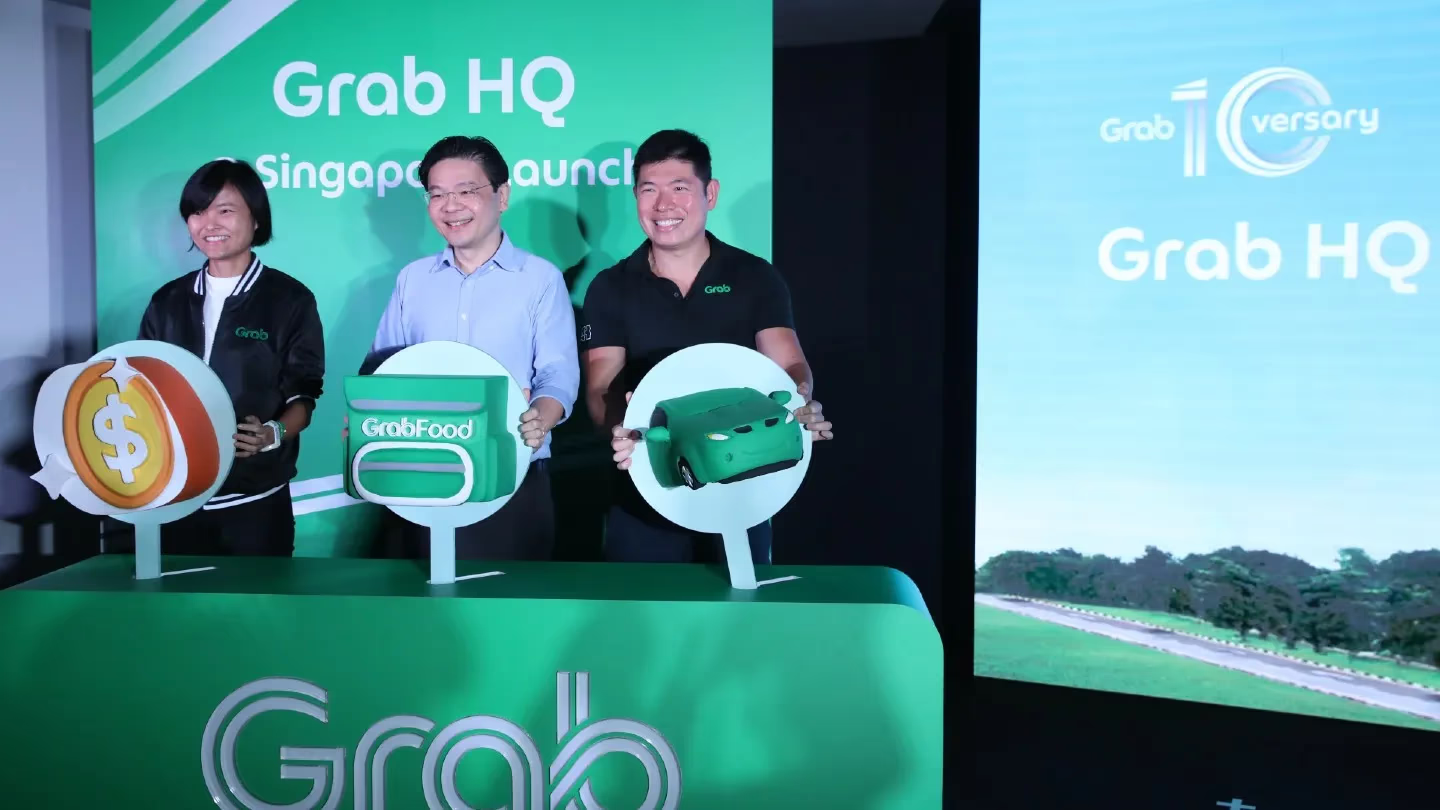
Tan Hooi Ling (Grab Co-Founder), Lawrence Wong (Singapore’s Finance Minister) and Anthony Tan (Grab Group CEO) at the 2022 opening of Grab HQ in Singapore. (Prime Minister’s Office Singapore)
On May 5, Singapore’s super-app Grab released unaudited financial results for the first quarter of 2026 (ending March 31), marking a notable performance as it surpassed analysts’ forecasts.
This is the 17th consecutive quarter in which Grab has sustained upward momentum in its profit metrics, with adjusted earnings before interest, taxes, depreciation and amortisation (EBITDA) reaching 154 million US dollars and net profit hitting 120 million US dollars. Revenue climbed 24% year-on-year to 955 million US dollars, topping analysts’ estimates of 921 million US dollars. This was accompanied by on-demand gross merchandise value (GMV) growth of 24% to 6.1 billion US dollars.
These results carry added weight given that Grab itself had flagged the first quarter as its “softest” of the year. Moreover, amid market turbulence triggered by the Middle East crisis, the figures point to the firm’s underlying resilience. As Anthony Tan, Group Chief Executive Officer and Co-Founder, put it, “our results demonstrate the resilience of our platform, especially as Southeast Asia navigates an uncertain macroeconomic environment from the fuel crisis”.
The sentiment was echoed by Chief Financial Officer (CFO) Peter Oey, who added, “our first quarter performance highlights our consistent execution and the growing operating leverage across our platform”.
Two key business strategies underpinned this performance: (1) the integration of 13 new artificial intelligence (AI) features to drive efficiency and enhance user experience; as well as (2) direct subsidies to partners—drivers and merchants alike—alongside an accelerated transition to electric vehicles (EVs) as a fuel cost management measure.
What does this mean for businesses?
The headline numbers tell a confident story, but perhaps the clearest signal of management’s conviction is Grab’s announced 400 millions US dollars share buyback programme—a move that typically indicates leadership believes the stock is undervalued and that the company’s near-term prospects are sound. For businesses and investors tracking Southeast Asia’s digital economy, this suggests Grab sees the current environment as an opportunity and is putting capital behind that view.
For Grab’s partners, the picture is equally reassuring. Through direct subsidies and an accelerated shift to EVs, the company is offering drivers a degree of cost predictability that is hard to come by amid the volatility stemming from the Middle East crisis.
About The Author