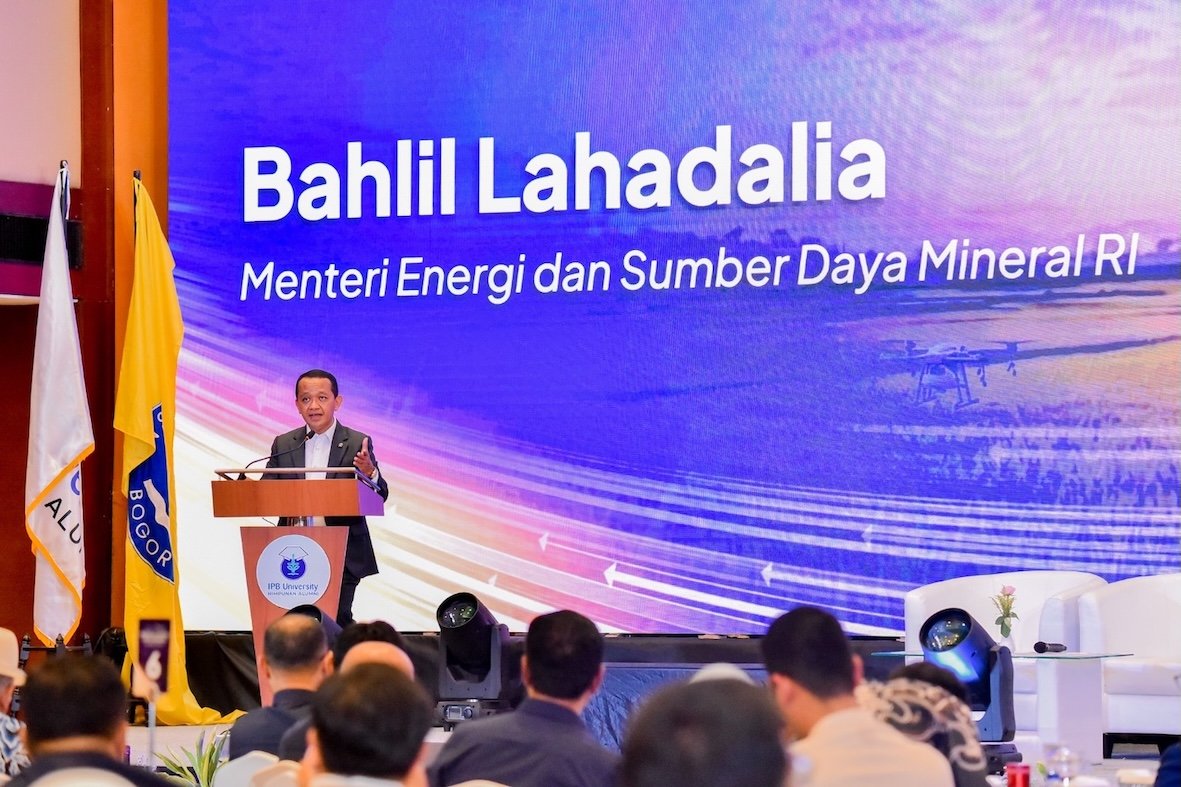
Indonesia’s Energy and Mineral Resources Minister Bahlil Lahadalia delivers his keynote speech at the IPB University Alumni Forum in Jakarta on 2 May. (Ministry of Energy and Mineral Resources Indonesia)
Indonesia will continue to rely on coal-fired power plants (CFPP) to safeguard its energy security and, in particular, electricity affordability.
Bahlil argued that the country cannot simply abandon coal, noting that “efficiency and national interests must guide Indonesia’s energy transition”. He elaborated by highlighting that developed nations—notably the US and European countries—are returning to coal to secure energy supplies. “The US is considering coal as an option and so is Europe, with some countries asking us to supply 20 million tonnes per year,” he said.
This pragmatic stance reflects a broader strategy that appears to be bearing fruit.
That said, Bahlil cautioned that the current state of national energy remains far from ideal as Indonesia aspires to achieve energy self-sufficiency yet remains heavily import-dependent. Nevertheless, Bahlil highlighted several milestones: (1) national oil production in 2025 successfully surpassed its state budget target; (2) hundreds of exploration areas with proven potential have been identified and are now being developed; and most notably, (3) the cessation of solar (diesel) imports is set for 2026.
To meet near-term demand and complement its coal reliance, the government is broadening its energy supply base—drawing from Africa, the Americas and Russia. Energy security, Bahlil stressed, is not forged through a single sweeping policy, but through a series of strategic steps carried out incrementally.
What does this mean for businesses?
Encouraging as these milestones are, the structural gap remains wide. Indonesia currently consumes around 1.6 million barrels of oil per day (bpd)—more than double its domestic lifting rate of 605,000 bpd. That shortfall means import exposure is not going away soon and businesses should plan accordingly.
For energy-intensive industries, continued coal reliance offers near-term price stability, but firms with environmental, social and governance (ESG) commitments may face growing pressure from international partners and financiers. Meanwhile, the government’s drive to diversify supply and ramp up domestic exploration shows ambition, though whether it will be delivered on time remains to be seen.
About The Author