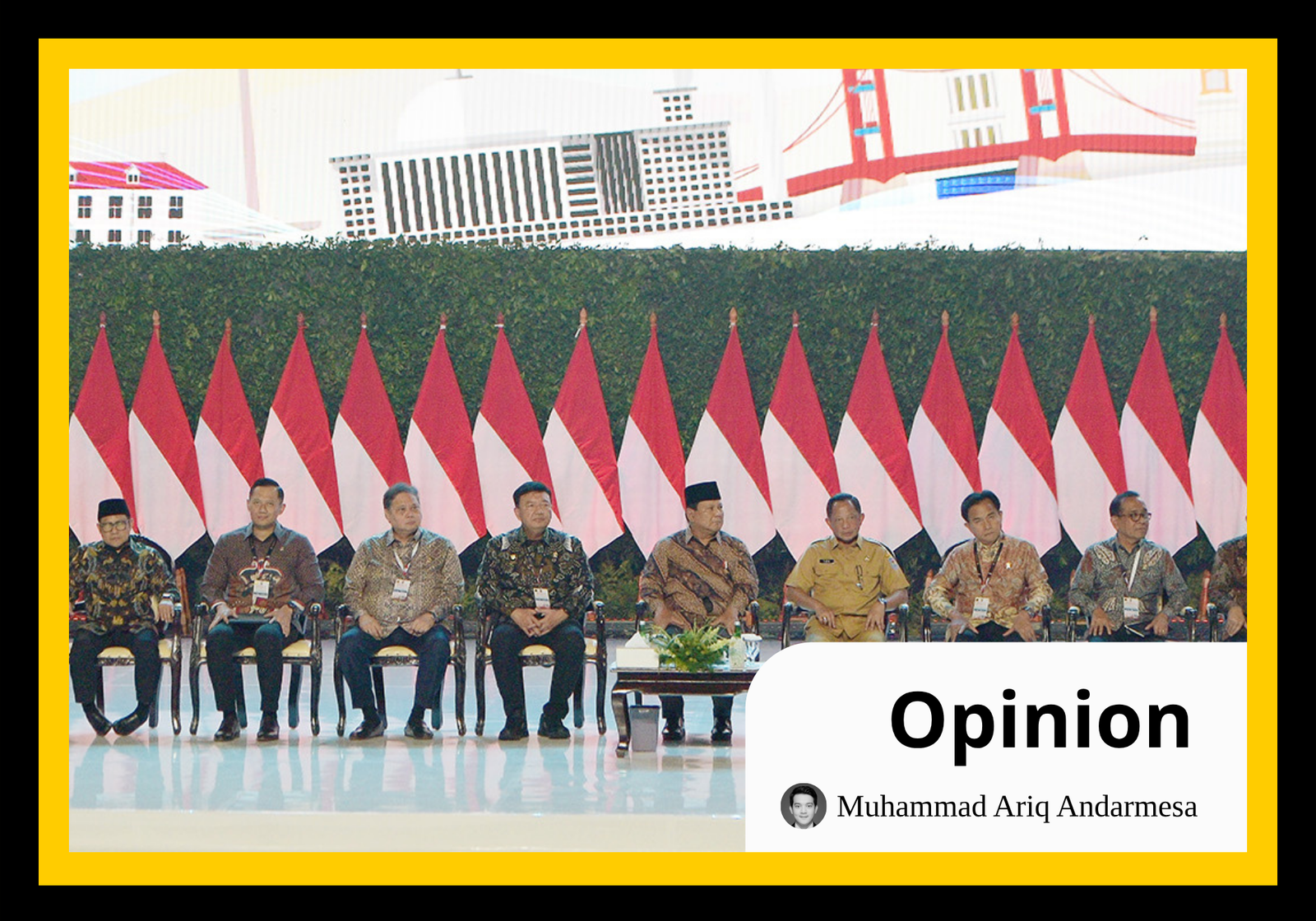
Convention between the Indonesian President Prabowo Subianto and regional leaders of Indonesia in November 2024. (Indonesian Cabinet Secretary)
Muhammad Ariq Andarmesa is a Political Science graduate of Padjadjaran University in Indonesia and writes on Indonesian industrial policy and political economy. The views expressed are his own and do not represent SEA Daily or that of another organisation.
Indonesia’s Golden Vision 2045 is one of the most consequential national projects in Indonesia. It promises stronger human capital, world-class infrastructure, wider prosperity and greater welfare for more than 280 million citizens. But aspirations alone do not create structural transformation. With growth stagnating, productivity uneven, and manufacturing under strain, Indonesia faces a narrowing window to escape the middle-income trap.
The central challenge is often misunderstood. Indonesia does not lack entrepreneurial talent, domestic demand or natural resources. It lacks a development model capable of converting these strengths into sustained technological upgrading. For decades, policy has leaned heavily on market liberalisation, commodity exports and relatively low-cost labour. These foundations generated respectable growth, but they have not consistently produced the industrial depth required for convergence with advanced economies.
The limits of commodity-led growth are increasingly clear. Indonesia is richly endowed with coal, palm oil, nickel, gas, and other natural resources. In 2024, coal remained one of Indonesia’s largest export earners, valued at roughly 30–34 billion dollars depending on classification, while palm oil exports reached around 23.3 billion dollars, or about 8.7% of goods exports. Yet this commodity concentration creates structural fragility. In 2023, Indonesia’s total exports fell 11.33%, from $291.98 billion dollars in 2022 to 258.82 billion dollars, a reversal of more than 33 billion dollars, largely linked to weaker global demand and lower commodity prices. By December 2023, nickel and natural gas prices were down 43% and 54% year-on-year, respectively, while coal and crude palm oil prices also declined sharply. At the same time, Indonesia’s high-technology exports declined from 12.31% of manufactured exports in 2010 to 9.08% in 2023, after dipping to 7.2% in 2021. The trajectory points to a deeper structural problem: export concentration is rising, while the shift toward higher-value, technology-intensive manufacturing remains too slow.
Manufacturing and the Risk of Premature Deindustrialisation
Many middle-income economies have encountered this pattern. Natural resources can finance development, but they rarely substitute for industrial capability. Malaysia’s early dependence on rubber and tin delayed its transition to electronics until Penang’s industrial zone was established with deliberate state support in the 1970s. Nigeria, despite vast oil revenues, has struggled to build a diversified industrial base and remains mired in the middle-income trap. Historically, transitions to high-income status have depended on shifting labour and capital into increasingly sophisticated manufacturing and tradable services. Without that shift, productivity growth slows and income convergence stalls.
Indonesia’s manufacturing trajectory, therefore, deserves urgent attention. Manufacturing has long been the most reliable channel for scale economies, technological learning, export discipline and broad-based productivity gains. It creates ecosystems of suppliers, engineers, logistics networks and managerial capabilities that spill over into the broader economy. Yet Indonesia’s manufacturing share of gross domestic product (GDP) has struggled to regain the dynamism of earlier decades. According to World Bank data, manufacturing value added accounted for 18.98% of GDP in 2024, only modestly above 18.67% in 2023, and still well below the levels achieved during Indonesia’s industrial peak, when the sector exceeded 30% of GDP in the early 2000s (reaching roughly 31.95% in 2002). This suggests that while manufacturing output continues to grow in absolute terms, its relative weight in the economy has declined over time as services and commodities expanded more rapidly. Meanwhile, competition from China, Vietnam, Thailand and other regional producers has intensified, placing additional pressure on Indonesia’s ability to climb higher-value segments of global manufacturing supply chains.
This resembles what economist Dani Rodrik calls premature deindustrialisation: developing countries seeing manufacturing peak at lower income levels and lower employment shares than earlier industrialisers. If this occurs before advanced capabilities are built, countries risk being trapped between low-value assembly and low-productivity services. That is a serious risk for Indonesia.
The implication is not that markets should be abandoned. It is that markets alone are unlikely to solve the coordination problems central to industrial upgrading. New sectors often require large upfront investment, patient capital, infrastructure, specialised skills, supplier networks and uncertain technological bets. Private investors may rationally avoid such areas because returns are distant and risks are high. What is individually rational for firms may be nationally suboptimal.
This is where the Developmental State becomes relevant.
Why Indonesia Needs a Developmental State
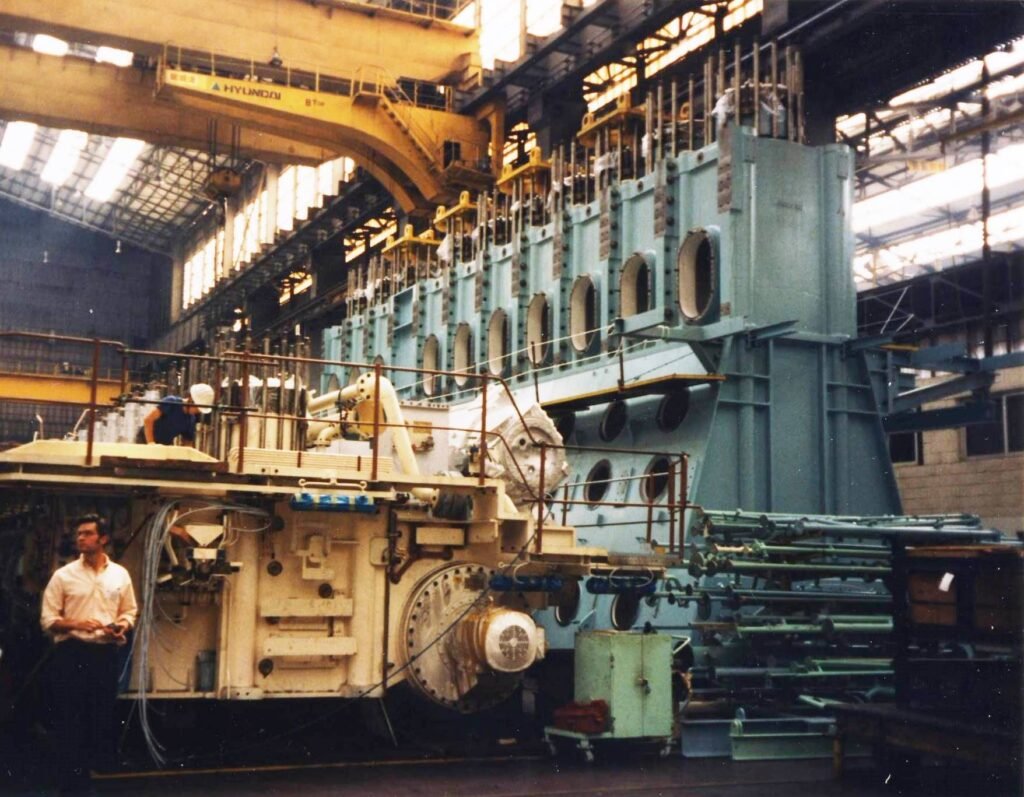
Ship engine under construction at Hyundai Ulsan Shipyard in 1994. (Wikimedia/Erremm)
The most successful East Asian transformations did not emerge from laissez-faire policy. Post-war Japan used a coordinated industrial strategy through institutions such as MITI to support steel, automobiles and electronics. South Korea combined export discipline with directed credit and strategic support for heavy industry, shipbuilding and semiconductors. Taiwan paired state guidance with technology institutions, upstream public enterprises and a dense SME ecosystem.
In recent decades, China has leveraged state-directed financing and strategic infrastructure to accelerate its ascent within global value chains through surgical industrial policy.
These countries did not reject markets. They shaped markets.
The East Asian Developmental State reduced uncertainty, coordinated investment, disciplined underperforming firms, and built capabilities that private actors alone were unlikely to create. In many cases, public institutions took risks long before private capital was willing to do so. This is the practical meaning of the state as an entrepreneur.
Indonesia should draw lessons from this experience while adapting them to democratic institutions and contemporary realities. The goal is not to copy twentieth-century bureaucracies, but to build modern Indonesian institutions capable of solving twenty-first-century industrial problems.
That begins with identifying strategic sectors where Indonesia can realistically compete. Downstream minerals processing is one example, but it should be only the start. Electric vehicle supply chains, battery materials, precision agro-processing, fisheries technology, medical manufacturing, renewable energy equipment, maritime engineering and defence industries all offer potential pathways. Indonesia’s large domestic market can provide scale, while ASEAN integration offers regional demand.
But sector selection alone is insufficient. Indonesia needs financing mechanisms aligned with industrial time horizons. Traditional venture capital often favours fast-scaling digital platforms rather than capital-intensive manufacturing. Banks may prefer collateralised lending to established sectors. A national development finance architecture is therefore essential: institutions willing to provide patient capital, co-investment, and technology-linked credit for firms meeting clear performance criteria.
Financing Industrial Transformation
This is where state-owned enterprises, sovereign investment vehicles and specialised development banks can play a constructive role—if governed well. Institutions such as the Indonesian sovereign wealth fund Danantara could become catalytic investors rather than passive asset holders, helping crowd in private capital for strategic projects. But credibility depends on governance, transparency, and insulation from patronage.
Institutional quality is ultimately decisive. Industrial policy fails when it becomes a channel for rent-seeking, protection without discipline, or politically connected monopolies. It succeeds when support is conditional, time-bound, and tied to measurable outcomes such as exports, productivity gains, localisation targets, R&D intensity or workforce upgrading. The state must be capable, meritocratic and willing to withdraw support from failure.
Indonesia also needs to invest far more seriously in human capital. No industrial strategy can succeed without engineers, technicians, managers and researchers. Vocational education, applied universities, industry partnerships, and stronger R&D ecosystems should be treated as core economic policy, not side issues. South Korea’s rise was built as much in classrooms and laboratories as in factories.
Some progress is already visible. Downstreaming policy, infrastructure expansion, and the renewed debate over industrial strategy suggest that Indonesia, is beginning to move away from passive economic management toward a more active developmental agenda. But incrementalism may not be enough. Indonesia’s Golden Vision 2045 is less than two decades away. Industrial capability takes years to build and even longer to mature.
The real choice facing Indonesia is not between state and market. It is between a passive state that manages short-term cycles while hoping markets deliver transformation, and a strategic state that partners with business to create new productive capacities.
History strongly suggests that no large nation has reached a durable high-income status without such a state role. Indonesia has the scale, resources, and talent to succeed. What it needs now is the institutional ambition to match them.
About The Author