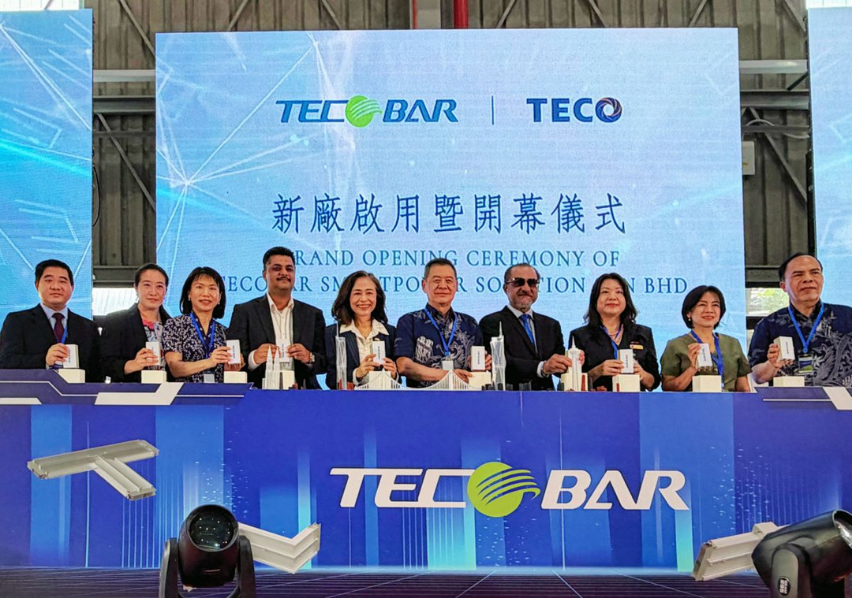
Officials gather at the inauguration of TECOBAR SmartPower Solution’s new armoured busway plant in Penang, Malaysia, on 29 April. (TECO Group)
The funding was realised through the establishment of “TECOBAR SmartPower Solution” via its subsidiary TECOBAR, which specialises in the production of busway systems—a modernised alternative to traditional cabling for electricity distribution. The new plant is dedicated to producing high-end armoured busway systems engineered specifically for the demanding power requirements of artificial intelligence (AI) data centres and high-performance computing infrastructure.
A ceremonial inauguration for the manufacturing plant was held in Penang, Malaysia, on April 29. TECOBAR Chairman Ta-Wen Lin noted that the Penang facility enables TECOBAR to synchronise its Taiwan-based resin busway production with Malaysia’s armoured busway manufacturing, forming a unified regional supply chain.
The plant is reported to hold an annual production capacity of 400,000 metres of busway—a scale that positions the facility as a vital manufacturing hub serving both the ASEAN region and international markets.
In line with net-zero commitments, TECO Chairman Morris Li stated that the facility is “equipped with smart manufacturing systems and energy-efficient technologies,” underscoring the group’s broader focus on sustainable operations and environment, social and governance (ESG)-aligned industrial growth.
What does this mean for businesses?
The investment is a direct response to surging demand from the AI and cloud computing sectors, where traditional cabling infrastructure is increasingly unable to keep pace. With an annual capacity of 400,000 metres, the Penang plant is well-positioned to serve as a strategic manufacturing core for both regional and global supply chains.
More broadly, this signals a wider opportunity: high-profile industrial commitments of this nature can serve as a catalyst to attract further foreign investment into Malaysia. However, that opportunity is contingent on Malaysia substantiating its credentials as a reliable industrial partner—one with robust infrastructure, a skilled workforce and a stable regulatory environment. The country must demonstrate that it can match investor ambition with the industrial foundations to sustain it.
About The Author