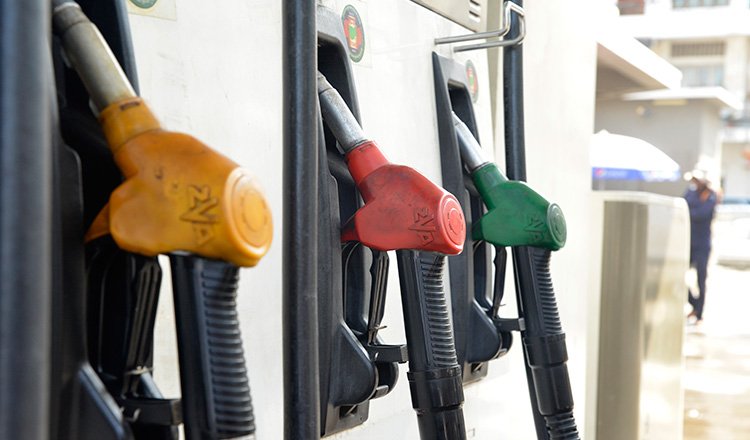
Fuel pump nozzles at a petrol station in Cambodia. (Khmer Times)
Phnom Penh ends April with a fuel price surge. Effective April 29, petrol (Gasoline 92) is priced at 5,510 Cambodian riels (1.37 US dollars) per litre, while diesel (Gasoil 10 parts per million (ppm)) costs 5,650 Cambodian riels (1.41 US dollars) per litre.
Prices are firm until the next official update. Notably, these figures reflect a price hike from the previous week. This is the sixth adjustment this month by the Ministry of Commerce, made in response to ongoing uncertainty stemming from the Middle East conflict.
Adjustments are made in accordance with the ebbs and flows of tensions in the Strait of Hormuz. On April 1, fuel prices began rising, reaching 5,500 Cambodian riels (1.27 US dollars) for gasoline and 8,100 riels (2.02 US dollars) for diesel by April 4. Prices for both fuels subsequently declined between April 15 and 18, remaining stable through April 24, when gasoline was tagged at 5,000 Cambodian riels (1.25 US dollars) and diesel at 5,400 Cambodian riels (1.35 US dollars) per litre.
In response, fiscal intervention was introduced to ease domestic pressures. Following a 47 million US dollar subsidy by the General Department of Customs and Excise (GDCE) on April 8, Notification No. 1374 on retail fuel prices was issued on April 24. It stated that the Royal Government has committed to implementing a discount of 260 Cambodian riels per litre (6.5 US cents) to ease the cost of living. Additionally, the value-added tax (VAT) has been reduced from 10% to 4% for gasoline and from 10% to 0% for diesel, with the government absorbing the remaining tax burden.
What does this mean for businesses?
Since the onset of the Middle East conflict, Cambodia has absorbed significant cumulative increases in fuel costs—petrol prices have climbed 41.5% and diesel by 94.8%. For businesses, these are not abstract figures. Fuel underpins nearly every layer of operational cost: logistics, cold chain storage, manufacturing and last-mile delivery. As Cambodia relies almost entirely on imported energy, it has limited capacity to buffer against global market shocks, leaving businesses exposed to price swings that are largely beyond domestic control.
While the government’s VAT reductions and per-litre subsidy offer short-term relief, they do not eliminate underlying vulnerability. Companies with thin margins—particularly in agriculture, transport, and manufacturing—face compounding pressure as input costs rise faster than they can be passed on to consumers.
About The Author