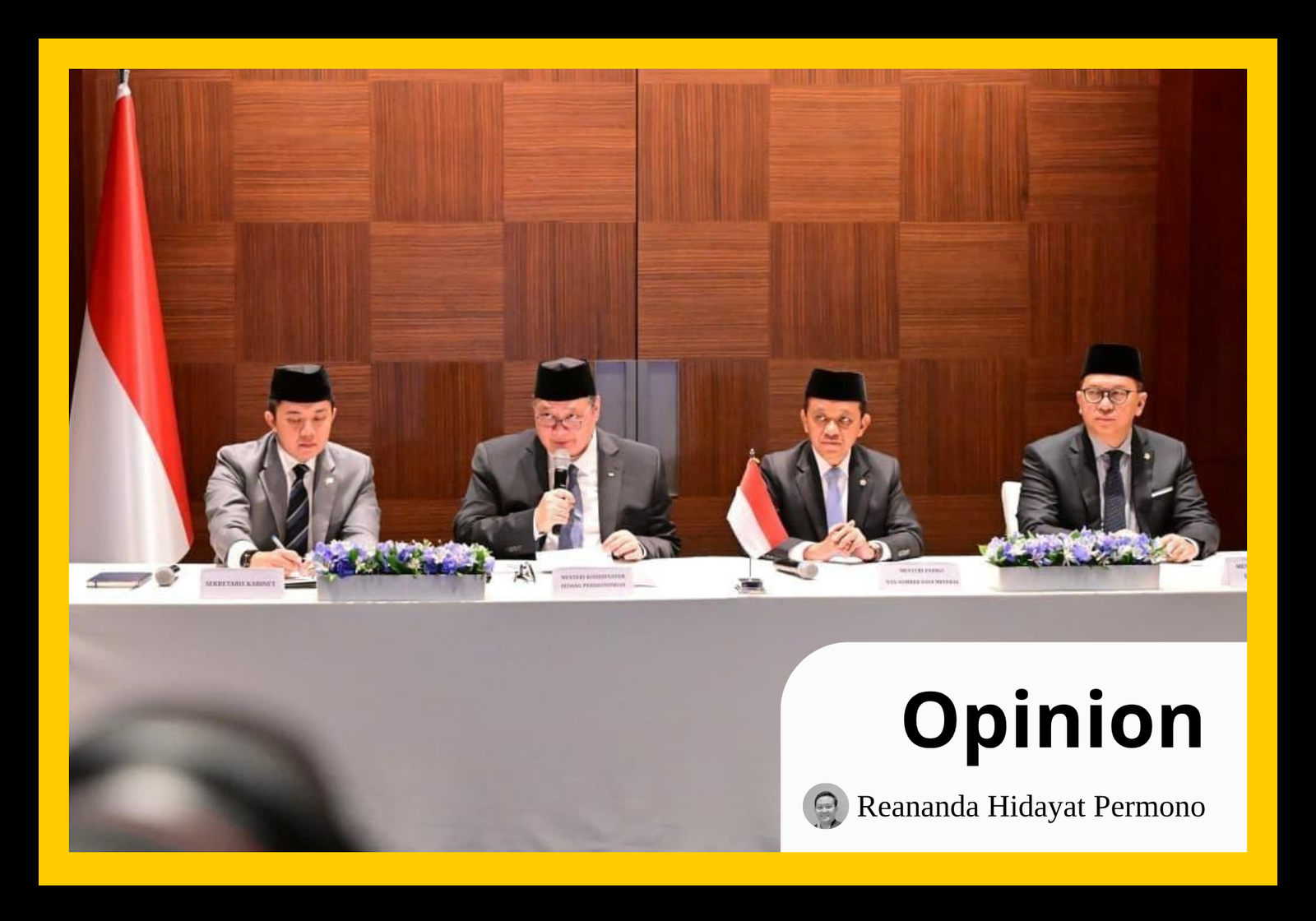
Press conference organised by Indonesian ministries to deliver updated policies in facing global geopolitical dynamics on April 1, 2026 (Coordinating Ministry for Economic Affairs of the Republic of Indonesia)
Reananda Hidayat Permono is Indonesia Project Manager for Transport & Environment (T&E). The views expressed are his own and do not represent SEA Daily or that of another organisation.
The Indonesian government has issued a one-day Work From Home (WFH) policy for civil servants at both the central and regional governments. Starting in April, the WFH arrangement will be in effect once a week, every Friday. The arrangement is also encouraged for the private sector, although it is not mandatory.
It is the latest effort from the government to respond to the rising oil prices due to the Iran war, which has severely disrupted global oil and gas supplies. Wholesale oil prices climbed past the critical 100 US dollars per barrel mark since the first week of March, hitting 119 US dollars per barrel in April. Furthermore, there has been a spike in fuel procurement costs due to higher transportation costs, caused by the procurement from alternative sources like the US, Brazil and Russia.
Indonesia has allocated 381 trillion Indonesian rupiah (22.4 billion US dollars) for fuel-related subsidies in the 2026 State Budget (locally known as APBN, totalling 3,842 trillion Indonesian rupiah or 230 billion US dollars) based on an assumed oil price of 70 US dollars per barrel. Even if the average oil price remains “only” at 94 US dollars per barrel, simulations from the Institute for Essential Services Reform (IESR) reveal that the subsidy budget will swell to 460 trillion Indonesian rupiah (26.6 billion US dollars) per year. The estimated Rp 6.2 trillion (359 million US dollars) in savings from the WFH policy, coming from the reduced spending on fuel subsidies, seems insignificant compared to the swelling subsidy budget.
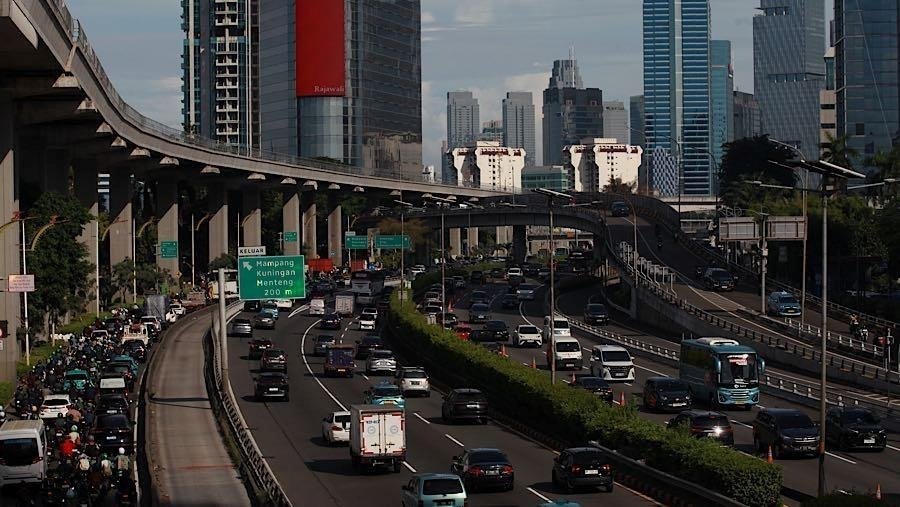
Traffic conditions in Jakarta on April 10, 2026 after the implementation of the WFH policy (Bloomberg Technoz)
The Limits of WFH as a Solution
There are more than 5 million civil servants in Indonesia. Around 1.2 million of them are based in the capital Jakarta, making up almost a third of the megacity’s daily commuters who usually endure a 20-30 kilometre trip each way. A survey from the Central Bureau of Statistics (BPS) shows that nearly 80% of those commuters use personal vehicles (either cars or motorcycles) to commute.
Besides focusing on fuel consumption, these statistics also favor the reduction of carbon dioxide (CO2) emissions since, according to the International Energy Agency (IEA), WFH can reduce CO2 emissions for car commuters for journeys longer than 6 kilometres. However, this assessment should be read with a grain of salt.
Firstly, WFH does not automatically guarantee reduced travels since people may instead shift from working at the office to working from anywhere (WFA) except home, using their personal vehicles to commute. Choosing Friday as the WFH day could even encourage people to take long weekend trips.
Secondly, the environmental benefits are small in the Indonesian context. Despite cutting emissions from , WFH could still lead to a small increase in CO2 emissions as a result of extra residential energy use. In Indonesia, the net emissions difference between WFO and WFH would be small as Indonesia’s energy sector is heavily reliant on coal power plants.
Instead of implementing temporary answers like WFH, the government must leverage this momentum to implement two long-term solutions for road transport decarbonisation: improve public transport systems and accelerate electric vehicle (EV) adoption.
Public Transport: Overcoming Weak Commitments from Local Governments
Encouraging civil servants to use public transport is a better strategy to save fuel while maintaining productivity than mandated WFH. However, such an approach faces a significant barrier as data from the UN-Habitat agency shows there is a significant disparity in public transport access in cities across Indonesia. Major cities like Jakarta and Palembang provide comfortable access to public transportation for more than 50% of their residents. On the other hand, cities like Banjarmasin and Cirebon lag, with less than 10% of their residents having comfortable access.
It is a direct consequence of weak political wills from local governments to provide proper public transportation systems. As of 2025, only 33 regional governments have allocated a budget for public transportation operations in their regional budgets (APBD). Moreover, the allocated budget only ranges from 0.2% to 3.1% of the APBD.
Since 2020, the central government has actually initiated a stimulus for regional governments in the form of the Buy The Service (BTS) scheme. The temporary subsidy should have established a foundation for regional governments as it has an eventual goal of independent regional financing. Unfortunately, many regions still highly rely upon the subsidy.
The central government must allocate sufficient and sustainable funds to ensure the continuity of public transport across the country since it has tended to decrease in the last two years. In 2024, the budget ceiling was set at 437.89 billion Indonesian rupiah (25.3 million US dollars), and it substantially dropped in 2025 (Rp177.49 billion (10.2 million US dollars)) and 2026 (Rp82.6 billion (4.7 million US dollars)).
Electric Vehicle: Shifting to Supply-Side Mandates
Accelerating EV adoption is the other vital long-term strategy to end Indonesia’s dependence on imported oil. Indonesia targets the adoption of 13 million electric motorcycles and two million electric cars on the road by 2030. The target is still far off, with only 236,000 electric motorcycles and 123,000 electric cars currently on the road. The inconsistent approach to incentives has been a roadblock for Indonesia.
For the electric motorcycles market, incentives were proven to be effective in 2023, with 80% of sales benefiting from some forms of subsidies. The Indonesian government must reenact the incentive since the suspension of incentives last year created a collapse in demand, with sales dropping by over 80% year-on-year in Q1 2025.
For electric cars, fiscal incentives such as the Value Added Tax borne by the government (PPN
DTP) and 0% Luxury Goods Sales Tax (PPnBM), as outlined in the Presidential Regulation No. 79/2023, ended in December 2025. Without continued support, electric car prices could jump by around 30-40%. Interestingly, the sale of electric cars in Q1 2026 continues to demonstrate a positive trend with 33 thousand cars sold, equal to almost 100% year-on-year growth.
After implementing fiscal subsidies that have attracted early investment, the government should shift toward robust supply-side mandates. It means strengthening local production while maintaining progressive Domestic Content Requirements (TKDN) outlined in the Presidential Regulation No. 79/2023. The TKDN target is set in several stages: 40% between 2022-2026, 60% between 2027-2029, and 80% by 2030.
Additionally, implementing “push” policies such as vehicle age restrictions is necessary to complete the action. Besides accelerating fleet renewal, a report from IESR confirms that Indonesia can only achieve a 2030 emissions peak from the transport sector if current policies are combined with vehicle age restrictions.
The government should use the momentum of rising cost of oil to pivot from short-sighted policies to long-term structural reforms in road transport decarbonisation. By allocating sustainable fiscal support for public transport across the country and pushing supply-side mandates to accelerate EV adoption, Indonesia can avoid reliance on vulnerable oil imports and achieve its genuine energy independence.
About The Author