
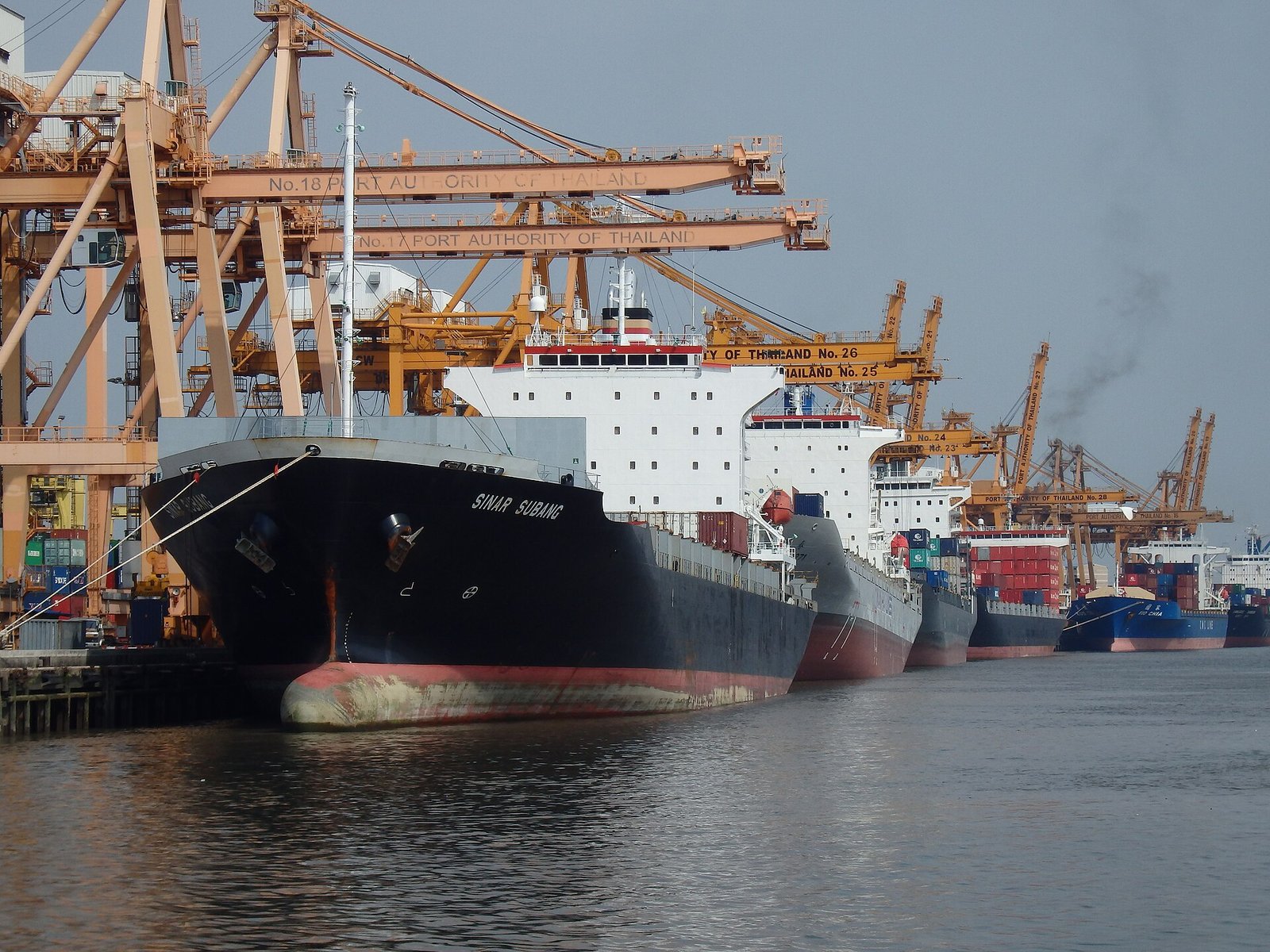
Sinar Subang cargo ship at Bangkok Port in 2015. (Wikimedia/mohigan)
Bangkok moves to seize the moment amid the Strait of Hormuz crisis, eyeing greater control over global maritime trade routes.
“Thailand will have a great advantage by operating the link between the Pacific Ocean and the Indian Ocean,” said Phiphat Ratchakitprakarn, Thailand’s Minister of Transport, in a press statement on April 21. The government has confirmed it will accelerate the construction of the Land Bridge project.
Rooted in a long-standing ambition to streamline shipping and boost the domestic economy, the Land Bridge initiative serves as an alternative to Thailand’s earlier plan to build a canal through the Kra Isthmus, which is the narrowest strip of land in Thailand’s southern region connecting the country’s west and east coasts. Under the administration of Prime Minister Anutin Charnvirakul, the project remains a flagship programme—a continuation of his predecessor’s vision.
The initiative is valued at nearly 1 trillion Thailand baht (30 billion US dollars) and is projected to create 200,000 new jobs. As a first step toward realization, the government must pass enabling legislation. Phiphat stated that the cabinet is expected to approve a draft bill later this year.
Fiscal constraints, however, have pushed the administration to adopt a 100% public-private partnership (PPP) model and to more aggressively court foreign investors. Countries such as the United Arab Emirates have expressed interest and are expected to assist in port operations, alongside companies like DP World and New World.
The project is expected to be completed by 2039. By then, the Land Bridge could offer an alternative to the Strait of Malacca, which currently handles 40% of global trade, cutting shipping times by four days and reducing shipping costs by 15%.
Regional pushback—particularly from Singapore, Indonesia, and Malaysia—is all but certain. Yet Phiphat was quick to temper concerns, arguing that the Land Bridge would not meaningfully undercut Singapore’s dominant transhipment role, but rather open a more direct corridor between the Indian and Pacific Oceans.
About The Author




One thought on “Thailand to accelerate construction of Land Bridge bypassing Malacca Strait”