
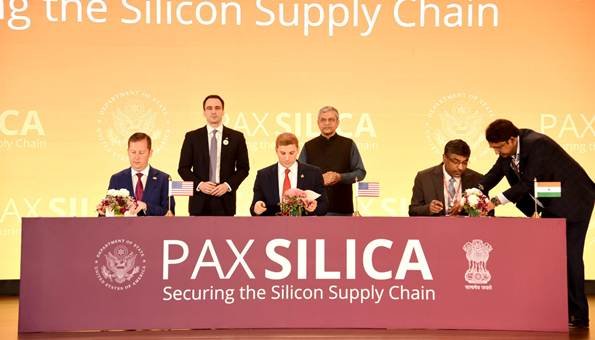
Signing of the Pax Silica Deal during the Global AI Summit in India in 2026. (Press Information Bureau of India)
Manila agreed to facilitate the US’—its long standing ally—effort to “shore up” supply chains. On April 16, Jacob Helberg, US Under Secretary of State for Economic Growth, Energy, and the Environment, mentioned a plan to establish a 4,000–acre (16,1 km2) industrial hub in the Luzon Economic Corridor. The fact sheet elaborates how the Philippines’ abundant critical mineral reserves and skilled talent complement US technological capabilities.
The ambition is part of the US ‘Pax Silica’ initiative, a strategic effort to mobilise its ally in securing global silicon stack. Launched in December 2025, the Philippines became the 13th signatory, but will be the first to pilot a new “artificial intelligence (AI)-native” investment model—meaning industrial operations within the zone are designed to be AI-driven from the ground up.
Details have yet to be published, but this move can be interpreted as a direct counter to Beijing’s growing dominance in the Indo-Pacific. The Philippines’ inclusion completes a ring of Pax Silica signatories encircling China, alongside Japan, South Korea, Singapore and Australia.
more controversially, the zone—spanning roughly 4,000 acres of Philippine soil—will be designated as an Economic Security Zone under Manila’s framework, yet will reportedly grant diplomatic immunity to US operators and allow rent-free use of the site for an initial two-year renewable term.
What does this mean for business?
The US has historically been Manila’s most crucial defence partner, making this economic pivot a significant shift in the alliance’s character, and one investors have long waited for.
For businesses, the zone offers robust, American-style contract certainty which is a familiar ground for Western capital. For the Philippines, it carries the promise of ascending the value chain from raw material exporter to active participant in advanced manufacturing. However, it will only materialise if Philippine firms and policymakers aggressively negotiate their place within the zone’s operations—or risk remaining a mere raw mineral supplier.
About The Author

One thought on “Philippines to become first AI-native economic security zone under Pax Silica”