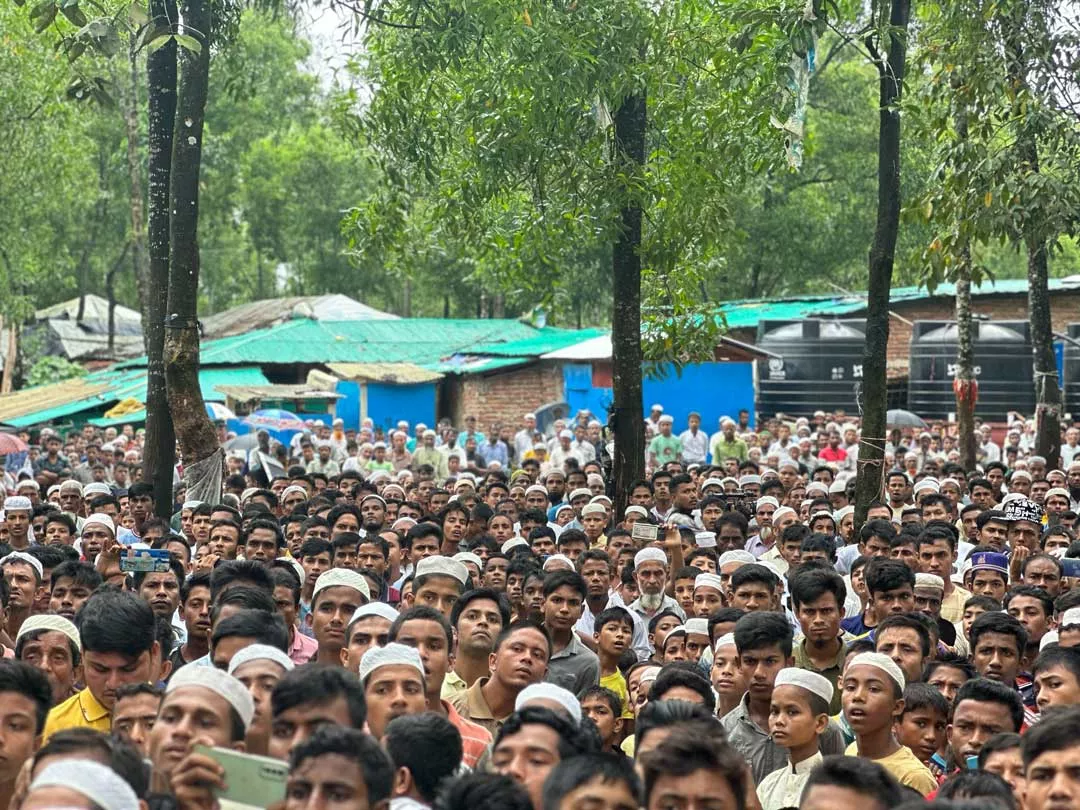
Rohingya refugees gather in Kutupalong Camp, Bangladesh, to mark Rohingya Genocide Remembrance Day amid worsening conditions and aid cuts, August 2023. (Nurul Absar)
The ARNC issued a statement that stated his appointment as ‘designed to legitimise continued military rule’. Moreover, the statement also called the previous election as ‘fundamentally illegitimate’ as it was ‘structurally controlled by the military’. In a similar fashion, the organisation further underlined Min Aung Hlaing’s involvement in persecuting the Rohingnya people, citing his prosecution in the International Criminal Court (ICC).
Separately, on April 6, Yasmin Ullah, a prominent Rohingnya human rights activist who fled Myanmar following the unending pressure and persecution, filed a legal charge to President Min Aung Hlaing over genocide charge. She was accompanied by a number of prominent former officials, non-governmental organisations, and former attorneys general at the Attorney General’s Office of the Republic of Indonesia.
The legal basis used was the principle of universal jurisdiction under the new Criminal Code, which has become part of case law. This principle allows states to prosecute individuals for extraordinary crimes under their national laws regardless of the location of the crime, the nationality of the perpetrator, or the victim.
The Rohingya, a Muslim ethnic minority from the Rakhine State, has endured decades of devastating discrimination and violence. The military junta has also been involved in the sectarian violence by introducing “four cuts” strategy and doctrine (Pya Ley Pya), which often employs excessive indiscriminate violence to civilians, destruction of collective infrastructure and blockade of humanitarian aid.
Consequently, the Rohingyas have been forced to flee Myanmar to seek protection in the neighboring countries. Bangladesh, which accommodates the most refugees, recorded a surge of 1 million Rohingnya in Cox’s Bazar. Other countries such as Indonesia, Malaysia, Thailand and India witness the same trend with less refugees.
Earlier on April 3, Min Aung Hlaing was elected to become the president of Myanmar, after winning 429 out of 584 votes within the in the Pyidaungsu Hluttaw, Myanmar’s bicameral legislature. He is accompanied by Nyo Saw (a former general) and Nan Ni Ni Aye (an ethnic Karen politician), who were elected as vice presidents.
While some allies countries, including China, Russia, Belarus and Nicaragua congratulated his appointment, numerous Western governments and human rights groups have largely condemned his ascension to presidency. Partly, some observers view this as an extension of a military rule with illegitimate credibility, manifested by the allegations of elections full of manipulation and suppression of legitimate groups by preventing them from participating in the elections.
About The Author