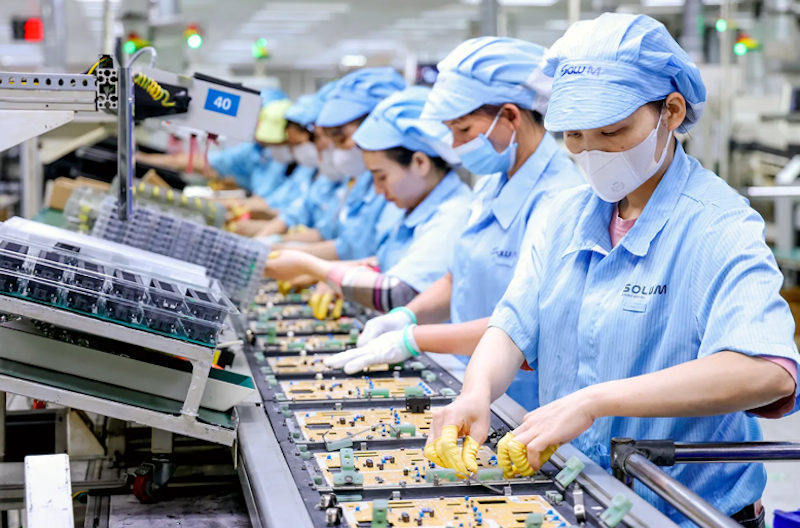
Production of semiconductor components at Solum Vina Company. (Hoang Nam/The Hanoi Times)
On March 17, strong inflows of technology-driven investment are positioning Vietnam as an increasingly important destination for high-quality foreign direct investment (FDI). A key development in early 2026 is a newly approved US$1.2 billion project in advanced electronic circuit board manufacturing, signalling continued investor confidence in the country’s high-tech ambitions. According to the Foreign Investment Agency, the project underscores Vietnam’s strategy of prioritising innovation-led and value-added investments.
In the first two months of 2026, newly registered FDI surpassed US$6 billion. Although this marked a 12.6% decline year on year, inflows remained resilient amid global uncertainty, including geopolitical tensions and shifting trade policies. Momentum improved in February, with registered capital rising to US$3.43 billion, up 34% from January. Meanwhile, disbursed FDI reached more than US$3.2 billion, increasing 8.8% year on year—the highest level for the period in five years—indicating that investment commitments are translating into actual capital flows.
Some indicators, however, point to continued caution among investors. Additional capital declined sharply by 52.3% to US$1.9 billion, while capital contributions and share purchases fell 5.7% to US$499.4 million, suggesting a more measured pace of expansion.
Despite this, Vietnam’s outlook remains positive. Global firms such as GE Vernova and G42 are expanding engagement, particularly in energy and digital infrastructure, reinforcing the country’s role in regional supply chains.
Vietnam’s growing focus on high-quality FDI creates expanding opportunities for businesses in advanced manufacturing, electronics and digital infrastructure. Companies may benefit from stronger integration into regional supply chains as multinational firms diversify production across Asia. Rising disbursement levels suggest improving project execution, supporting local suppliers and partnerships. However, the decline in additional investment indicates that firms should adopt cautious, phased expansion strategies while monitoring global risks. Vietnam’s stable policy environment and extensive trade network enhance its appeal, but competition for high-tech investment across the region is intensifying. Businesses that align with innovation, technology transfer and higher value-added production are likely to be best positioned to capture long-term growth opportunities.
About The Author