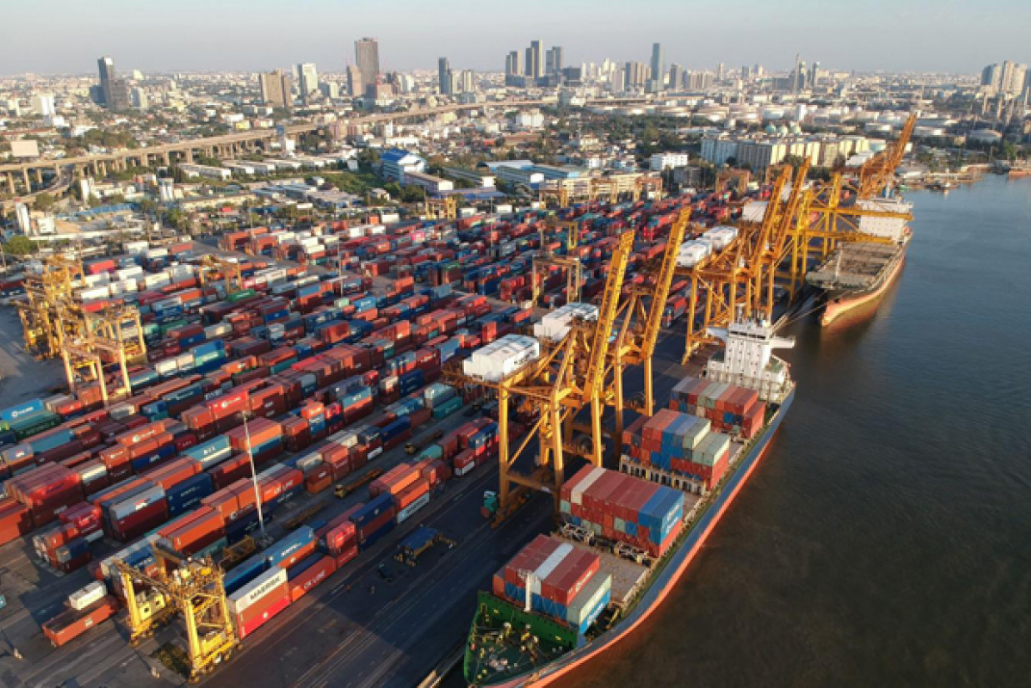
A view of the port of Bangkok, Thailand. (Bangkok Post)
On March 8, Thailand recorded a strong export performance in 2025, with international trade reaching a record US$339.6 billion (THB11.138 trillion), up 12.9% from 2024 and exceeding the government’s 2–3% growth target. Exports also remained robust at the start of 2026, rising 24.4% year on year to US$31.57 billion in January, marking the 19th consecutive month of expansion.
Despite this momentum, the Trade Policy and Strategy Office (TPSO) has warned that Thai exports face growing risks from geopolitical tensions, trade polarisation and currency movements. Key concerns include retaliatory tariffs linked to US President Donald Trump, and the impact of conflict between the United States and Iran, which has disrupted shipping routes through the Strait of Hormuz and pushed up energy and logistics costs.
Thailand’s export structure also remains highly concentrated. The five largest markets—the US, China, Japan, India and Malaysia—accounted for 48.6% of exports in 2025. According to the Director of the Trade Policy and Strategy Office, Nantapong Chiralerspong, Thailand must strengthen export resilience as global trade becomes increasingly polarised.
To address these challenges, the Commerce Ministry has introduced a “Resilience” strategy built on three pillars: diversifying export markets into regions such as the Middle East, Africa and South Asia; accelerating Free Trade Agreements (FTA) with partners including the EU and UAE; and adapting exports to emerging trends such as future food, environmentally friendly products under the BCG model and digital commerce.
In terms of implications for businesses, Thai exporters face a more volatile global trade environment shaped by geopolitical tensions, rising energy costs and shifting supply chains. Companies should reduce reliance on a few major markets and explore emerging regions to mitigate demand shocks. Leveraging new free trade agreements may provide tariff advantages and support market expansion. At the same time, businesses may need to upgrade production towards higher-value and sustainable products while adopting digital trade channels to remain competitive in an evolving global economy.
About The Author