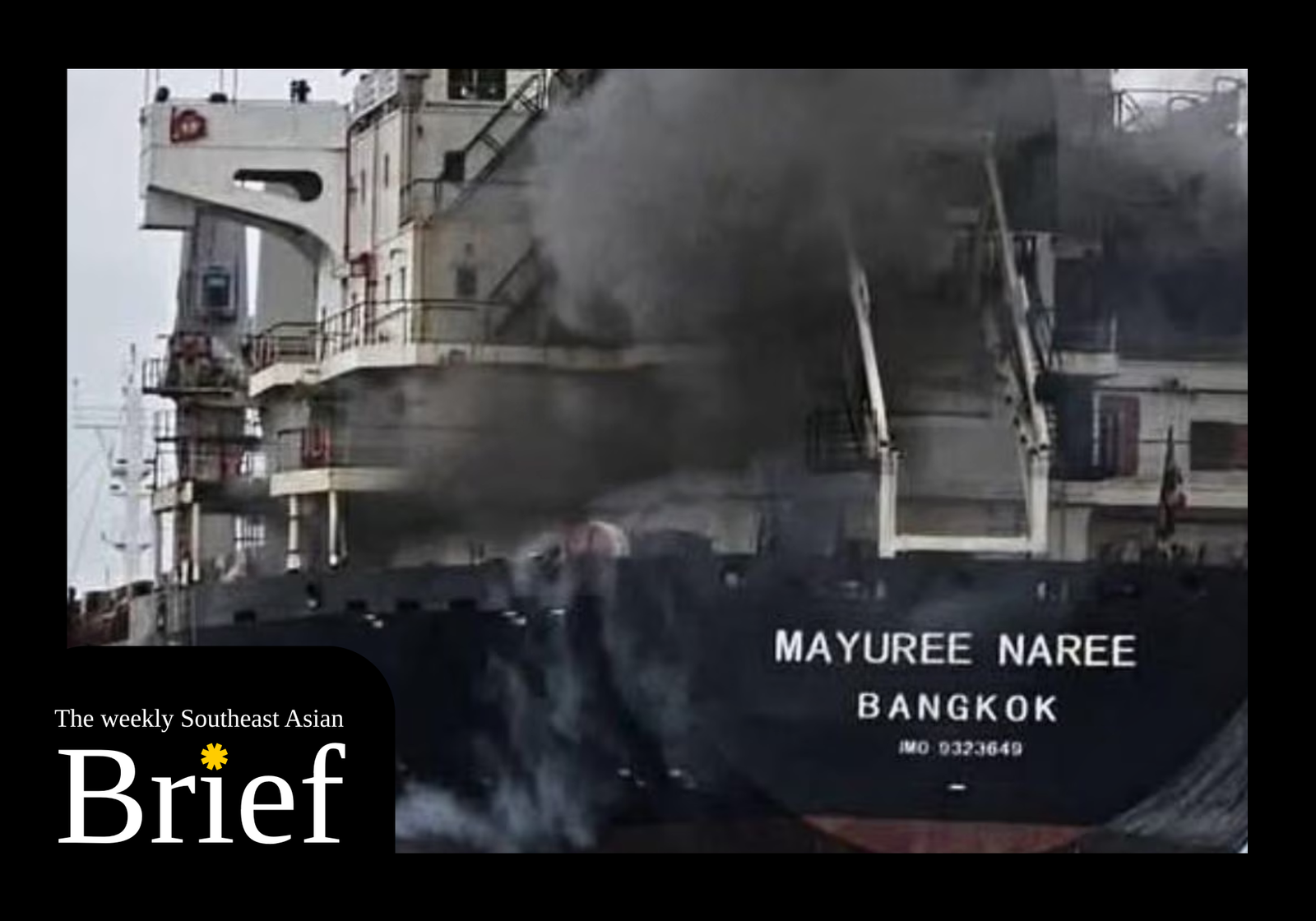
Thai-flagged carrier, Mayuree Naree, was struck by Iranian projectiles during its transit through the Strait of Hormuz on March 11, 2026. (Royal Thai Navy)
Iran has retaliated against US-Israeli attacks by blocking the Strait of Hormuz, which is an important global node for oil and gas distribution. Southeast Asia, which relies on the Middle East for 60% of its oil imports, is hard hit.
Southeast Asian governments respond differently to the oil and gas shortage in each country. Some countries have insulated their energy supply, while most states manage with policy. Landlocked and less-developed countries, however, remain particularly vulnerable to crises.
Insulated countries, namely Singapore, Brunei, Malaysia, and Timor-Leste were better positioned. Singapore’s energy company GasCo, conscious of its 70% LNG dependence on the Middle East, has an existing LNG stockpile.
Malaysia, a net energy exporter, has sufficient reserves until May 2026 and profited from a 12.5% increase in oil revenue. Nonetheless, its supply chain disruption has increased the domestic prices and impacted the agricultural sector, forcing the government to maintain RON95 subsidy.
Timor-Leste and Brunei have seen gasoline and diesel prices rise, though widespread shortages have not yet occurred.
Countries with policy intervention—Indonesia, Vietnam, the Philippines, and Thailand—have managed with tight policing. Indonesia has a sufficient inventory of fuel ration until the end of March. However, price fluctuation due to the supply shock remains a challenge. To maintain domestic demand, the government plans to introduce a four-day working system.
Vietnam, which imports 85% crude oil and other petrochemicals from the Middle East, seeks alternative sources from Japan and South Korea while activating its petrol price stabilisation fund.
The Philippines, which is 90% reliant on Middle Eastern crude oil, has introduced tight government intervention. President Marcos Jr.’s administration is handing out cash for motorcyclists and jeepney drivers, cutting LNG use, reverting to coal-fired power, enforcing a four-day workweek, and restricting cooling system setting below 24°C.
Thailand suspended most overseas trips for bureaucrats, curbed air conditioning use, dimmed billboard brightness from 10pm onwards, closed petrol stations, and will consider suspending oil exports from the country. The Thai government also welcomed new supplies from Angola and the US.
Thailand, the Philippines, Malaysia and Brunei, heavily depend on crude oil imports. Therefore, this critical situation disrupts between 60 and 95% of their energy supply chains.
Thailand suspended most overseas trips for bureaucrats, curbed air conditioning use, dimmed billboard brightness from 10pm onwards, closed petrol stations, and will consider suspending oil exports from the country. The Thai government also welcomed new supplies from Angola and the US.
Thailand, the Philippines, Malaysia and Brunei, heavily depend on crude oil imports. Therefore, this critical situation disrupts between 60 and 95% of their energy supply chains.
The most vulnerable cluster—Laos, Cambodia, and Myanmar—are vulnerable to fuel shortages and soaring prices due to their lack or limited oil refining capacity.
Cambodia only had a third of its 6,300 petrol stations operational last week, and was seeking Singaporean and Malaysian supply to make up for the sudden shortfalls.
Laos is heavily impacted by the war, as 40% of the 2,538 gas stations have been closed. The country also witnessed a 50% increase in diesel prices. Vientiane introduces a tax reduction and subsidy on gasoline and diesel to prevent domestic price rise. Furthermore, it will facilitate the purchase of electronic vehicles by over 30% cost reduction.
Myanmar is facing fuel shortages, which are impeding staple supplies, disrupting domestic trade flows and humanitarian operations. As a result, the junta has limited the use of personal vehicles.
The ripple effects have led to new potential trade channels. China has offered to assist Southeast Asian countries as a strategic part of its new five-year plan, offering its nuclear and renewable capacities as dependable alternatives.
Some governments are exploring broader suppliers, including from non-traditional suppliers to Southeast Asia, including the US and the EU.
Meanwhile, ASEAN, as the regional bloc, has warned member states to ‘[minimise] disruption to the flow of energy and essential goods, including food, to safeguard economic stability’. In the long term, this crisis can reshape the region’s energy security strategy, pushing the governments to diversify suppliers, increase renewable energy capacity.
About The Author