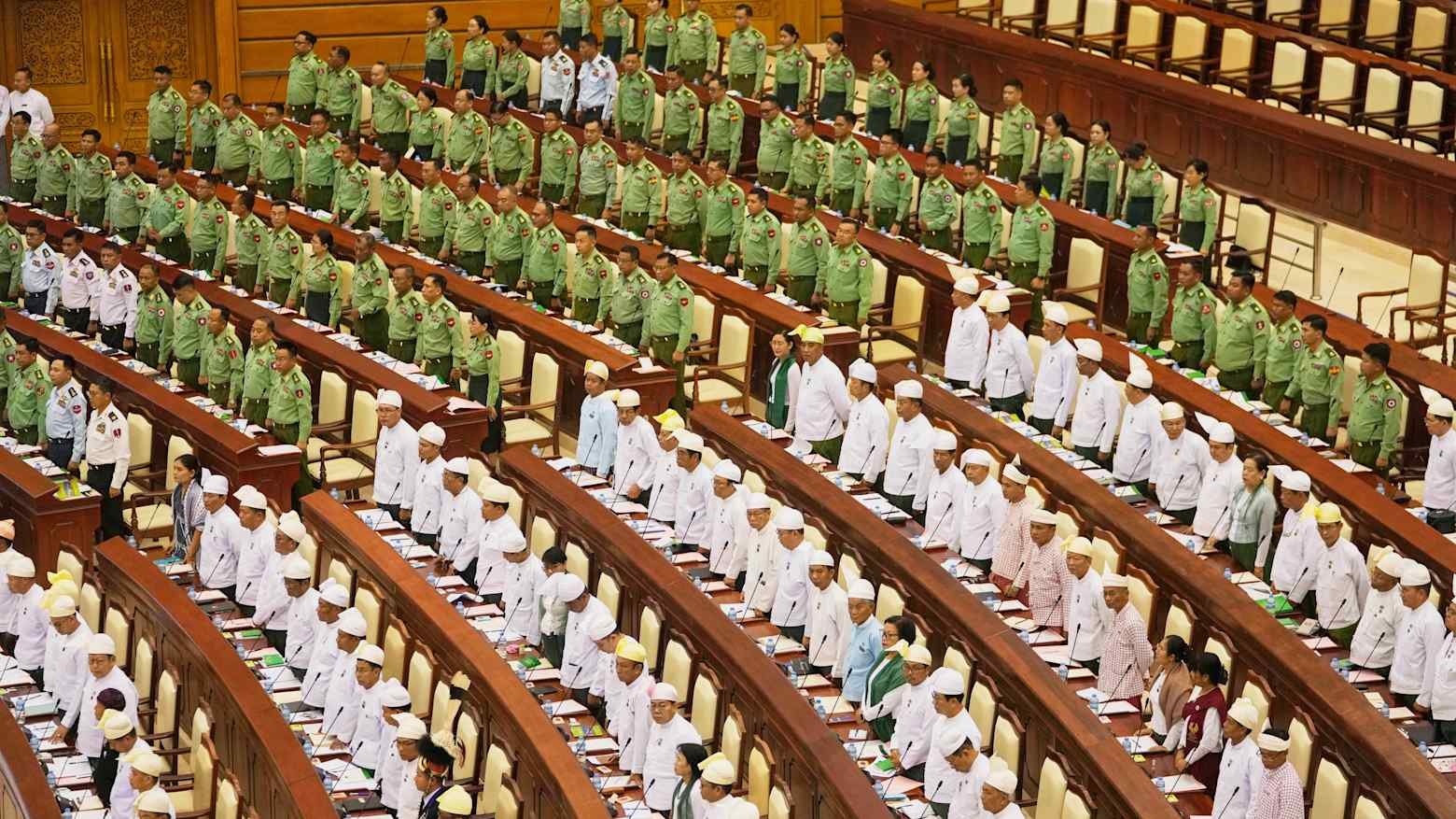
Military representatives and lawmakers take the oath during a parliamentary session in Naypyitaw, reflecting the continued political role of Myanmar’s armed forces. (AP)
Myanmar convened its first post-coup parliament plenary session in the capital Naypyitaw on March 16. With the pro-junta Union Solidarity and Development Party (USDP) holding a majority in the parliament, the key agenda was the election of retired general Khin Yi as Speaker and Maung Maung Ohn as the Deputy Speaker of the Lower House (Pyithu Hluttaw).
Following the February coup in 2021, the military regime halted any efforts to use democratic institutions and mechanisms. Any attempts to pass laws and budgets, as well as to control government finances, vanished. It was not until 2025 that democratic mechanisms began to be reintroduced.
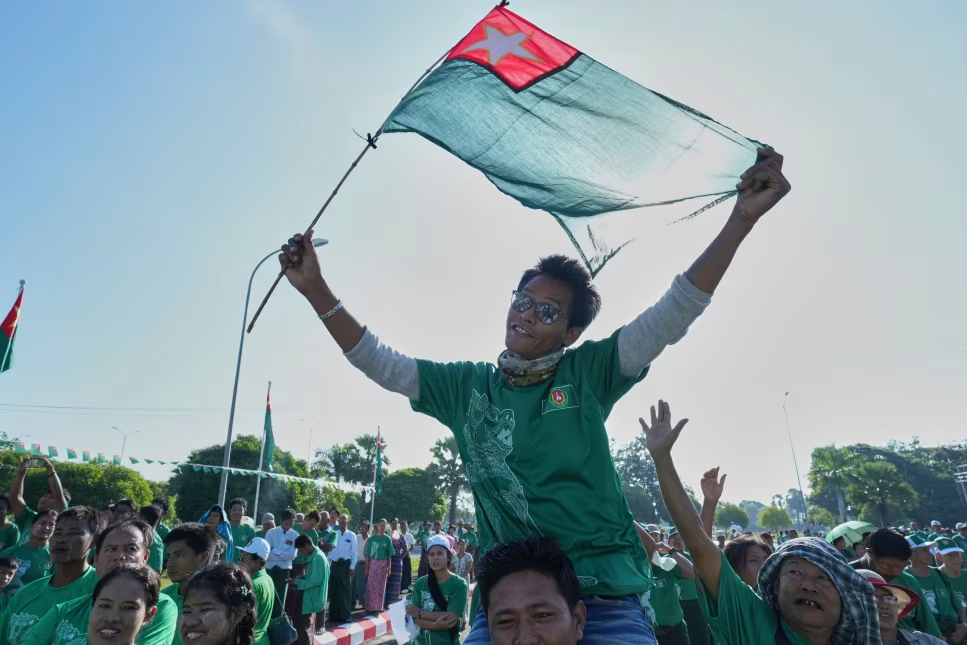
The junta-run general election in December 2025 and January 2026—surrounded by allegations over suppression, manipulation and violence, according to the UN—became the sole formal means to elect lawmakers. Moreover, the government excluded major opposition parties, ensuring the dominance of the pro-junta factions. The initiative is widely seen as a hallmark of the military regime’s claim to legitimacy and attempts to embed itself within the democratic institutions.
However, elections were also only held in certain areas dominated by supporters of the military regime. Other opposition parties were prevented from joining the contestation. Unsurprisingly, pro-junta parties secured 90% of parliamentary seats. On Wednesday, the upper house will convene its first meeting.
Ahead of the first parliament meeting, the UN Special Rapporteur for Myanmar, Tom Andrews, presented his report and observations to the UN Human Rights Council. Andrews emphasised the widespread violence and deprivation among civilians in the country. Moreover, he stated that over 12 million people face acute hunger, which is prompting a humanitarian emergency.
He further said, “Actions by the international community to weaken the military junta’s ability to sustain itself and its attacks on the people of Myanmar have shown promise.”
Myanmar has faced its internal hurdles since the military forcefully seized power from the democratically-elected leader Aung San Suu Kyi. Subsequent to the coup, the regime tightened its grip on power by jailing and even executing civilians deemed to be subversives.
About The Author