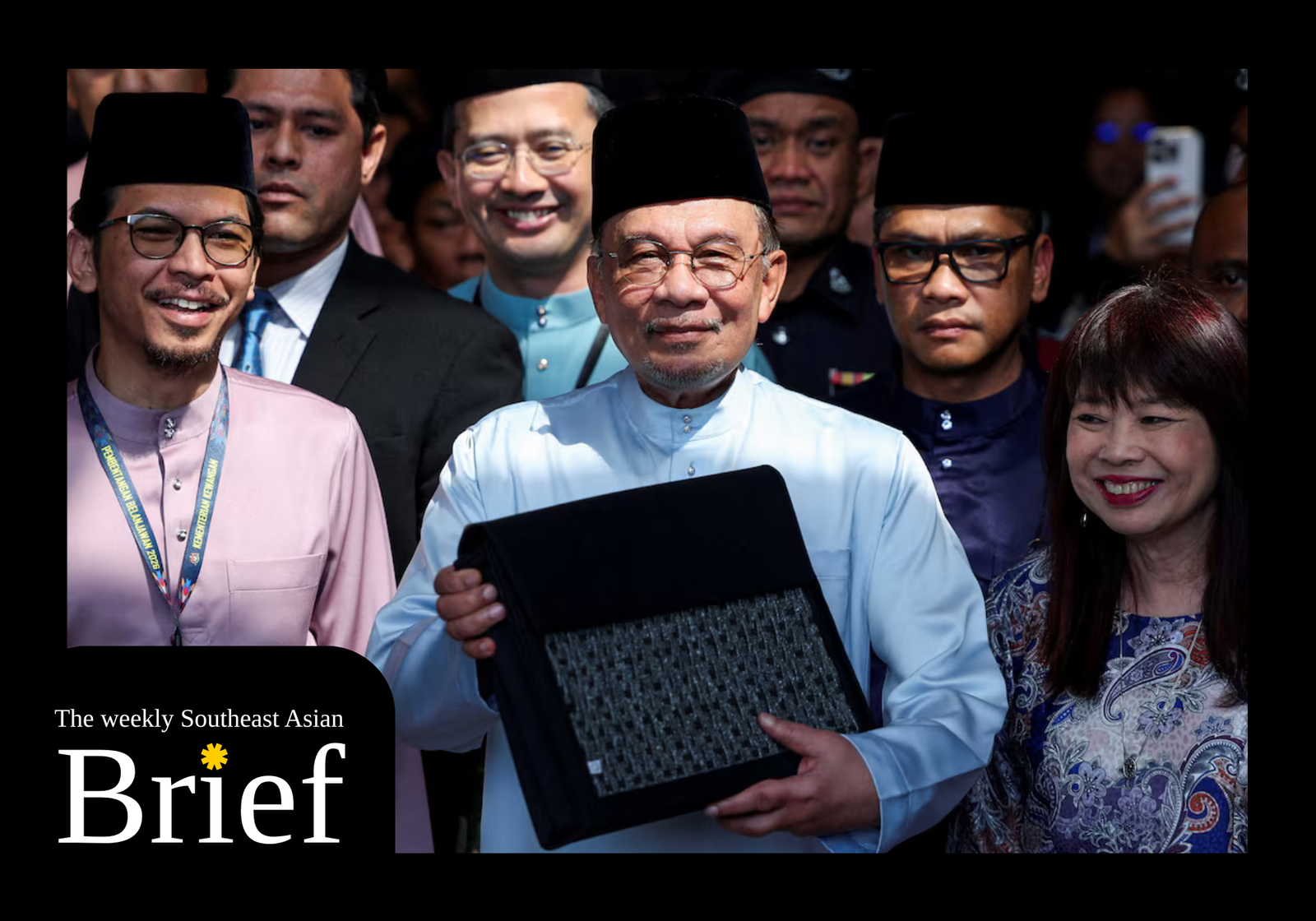
Malaysia’s Prime Minister and Finance Minister, Anwar Ibrahim, holds the 2026 national budget document at the Finance Ministry building as he departs for Parliament to table the budget, in Putrajaya, Malaysia, on October 10, 2025. (Reuters)
Malaysia’s Parliament just voted down a constitutional amendment bill tabled on March 3 aiming to limit the Prime Minister (PM)’s term in office.
The bill fell two votes short of the two-thirds majority required for constitutional amendments. A total of 146 Members of Parliament voted in favour, none voted against, 44 abstained, and 32 were absent.
Certain MPs who were reportedly supportive of the bill were nevertheless absent during the vote, allegedly due to logistical shortcomings on the part of the government, as they had not been properly informed to turn up.
It was also reported that several opposition MPs abstained because they had misunderstood the proposed ten-year limit as a provision that would allow Anwar Ibrahim to remain prime minister for ten years.
The bill—one of several institutional and political reforms promised by the ruling coalition Pakatan Harapan (PH)—deliberately framed the limit in terms of years rather than parliamentary terms, to de-link the premiership from electoral cycles or the dissolution of Parliament.
Following the defeat, Malaysia continues to have no constitutional cap on how long a prime minister could remain in office. The government has indicated it intends to retable the bill at the next parliamentary session in June 2026.
Among Southeast Asian countries, only a few impose explicit tenure limits on their chief executives.
Indonesia, following constitutional reforms completed by 2002 (first applied in the 2004 presidential election), limits the presidency to two five-year terms, while the Philippines restricts its president to a single six-year term.
Supporters of the amendment argued that limiting the PM’s tenure would help reduce the longevity and concentration of executive political power and promote good governance.
However, some analysts have suggested that such a reform may remain largely symbolic unless accompanied by broader institutional changes strengthening checks and balances.
These could include measures such as enhancing judicial and prosecutorial independence, establishing an ombudsman-type mechanism, adopting a freedom of information law, and enacting comprehensive political financing legislation, among other reforms frequently discussed in Malaysia’s governance and institutional reform debates.
They also note that formal term limits are more commonly associated with presidential systems. In Westminster-style parliamentary systems, by contrast, the executive emerges from the legislature and remains politically accountable to it, rather than being directly elected for a fixed personal mandate.
About The Author