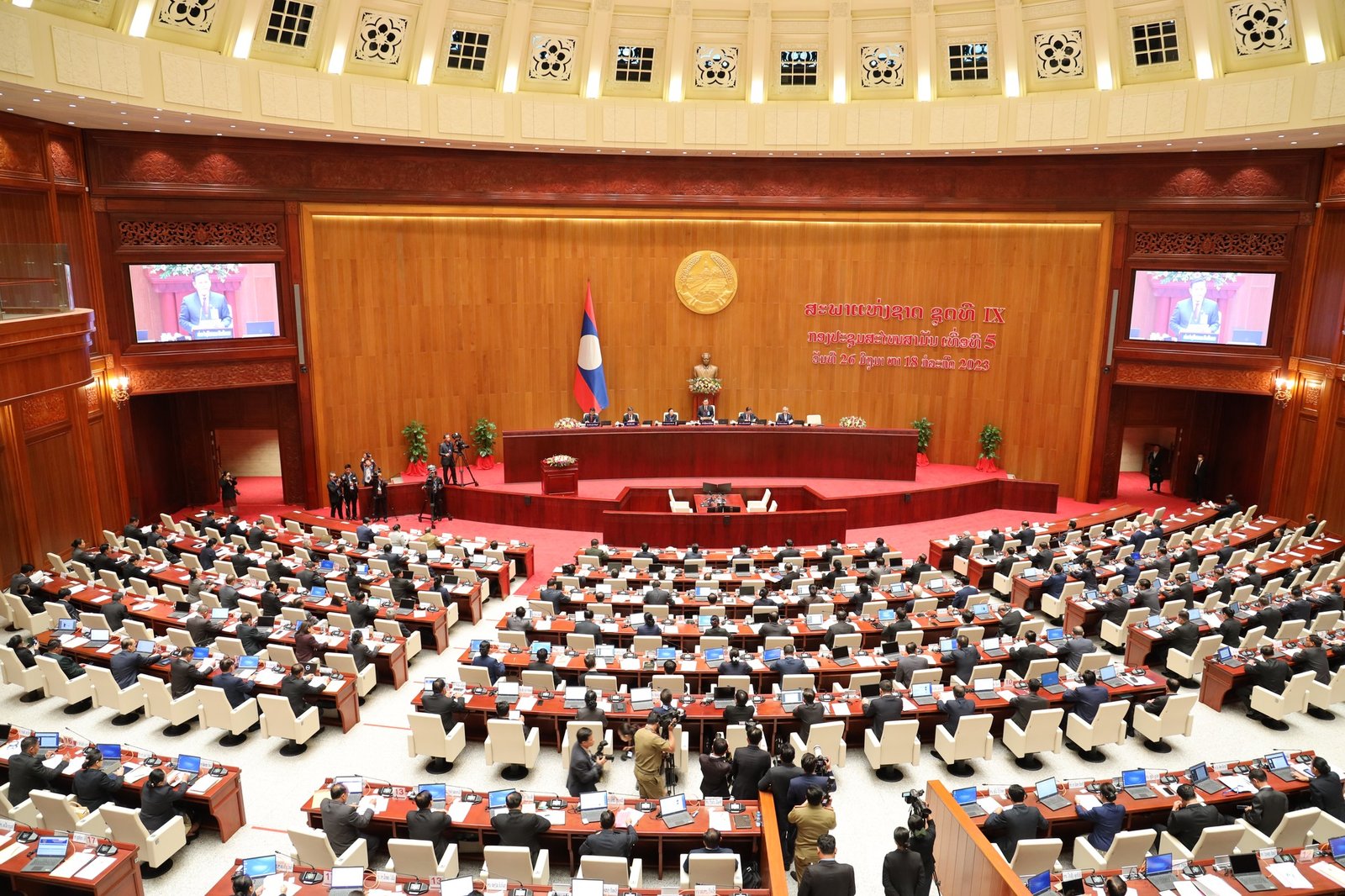
The National Assembly of the Lao PDR, the country’s legislative body. (National Assembly of Lao PDR website)
Laos has concluded its first 10th legislature’s first session on March 27. Discussions covered a wide range of issues from leadership transition, approval of strategic framework and judicial mechanism. During the session, the assembly elected the president, prime minister and the president of the National Assembly.
Furthermore, the lawmakers in this session approved 10th Five-Year Socio-Economic Development Plan, a strategic framework which directs Laos’ long-term goals. Several high officials also attended the meeting, such as the Secretary-General of the Lao People’s Revolutionary Party (LPRP) Central Committee, Thongloun Sisoulith, and other government functionaries.
One key agenda item was the approval of the Laos railway project that connects Thakhek and Vietnam’s Mu Gia border gate by the Lao National Assembly. This decision was made during the inaugural session of the 10th legislature that lasted five-day from March 23-27 in Vientiane led by the President of the National Assembly Xaysomphone Phomvihane. The proposed plan used a public-private partnership (PPP) scheme where a private entity finances, designs and builds the infrastructures to develop the East–West Economic Corridor.
The assembly also formalised the key agenda of the law enforcement and judicial institutions, including the Prosecutor General of the Supreme People’s Procuracy, the President of the Supreme People’s Court and the President of the State Audit Authority, the President of the State Inspection Authority.
In addition, the Laotian legislators also introduced the enactment of 19 new laws and the amendments of 72 remaining laws in its constitution. These revised and proposed laws will be affecting economic, social, and administrative sectors.
Previously, Laos had convened its 12th National Congress of the LPRP, in early January 2026. Its major agenda was the development agenda that was intended to lift the country out of the Least Developed Country (LDC) status. The 10th legislature session was a continuous effort to address the key challenges such as high debt pressures and inflationary risks.
About The Author