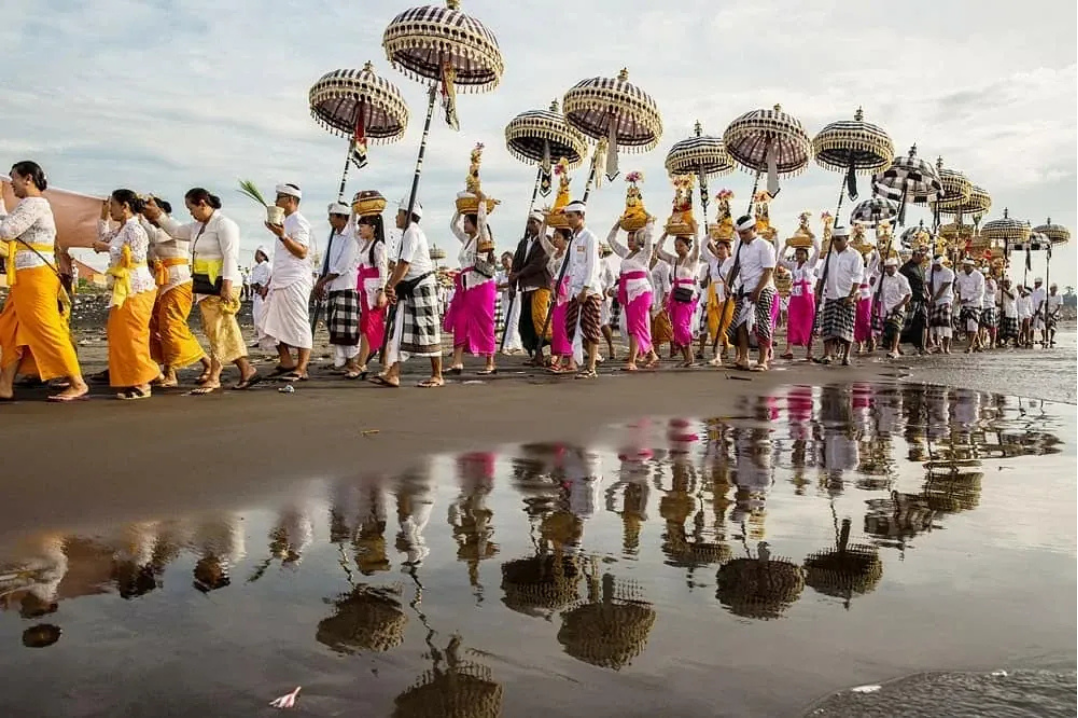
Melasti is a purification ceremony in Balinese Hinduism, held three to four days before Nyepi. (MyBalitrips.com)
Nyepi, also known as the Balinese Day of Silence, is a sacred Hindu celebration observed annually to mark the Saka New Year. Held this year on 19–20 March 2026, the occasion sees the island of Bali come to a complete standstill — no travel, no work, no entertainment, and no artificial light. It is a day devoted entirely to stillness, self-reflection, and spiritual purification.
According to Dr Ida Made Windya, an academic at the Institut Agama Hindu Negeri (IAHN) Mpu Kuturan Singaraja in Bali, this year’s Nyepi carries a meaning that extends well beyond religious ritual. In his view, Nyepi represents a quiet but powerful critique of the modern world’s relentless pace and culture of consumption. “In silence,” he argues, “Humanity can truly find its direction.”
At the heart of Nyepi lies the Catur Brata Penyepian — four key principles of self-restraint encompassing the suppression of desire, the cessation of activity, the restriction of movement, and the avoidance of pleasure. In an age dominated by social media and constant digital noise, Dr Windya notes that younger generations are increasingly viewing Nyepi not as mere obligation, but as a genuine need — a form of digital detox and mental restoration.
Beyond personal wellbeing, he also highlights the environmental significance of the observance. The near-total halt of human activity results in measurably cleaner air and quieter surroundings, reflecting the Hindu principle of Tri Hita Karana — the balance between humanity, nature, and the divine. In the context of the global ecological crisis, Nyepi serves as a striking reminder of the profound impact human behaviour has upon the earth.
However, Dr Windya raises concerns about a gradual shift in focus. On the eve of Nyepi, communities across Bali take part in the Ogoh-ogoh parade — a vibrant, torch-lit procession featuring enormous hand-crafted effigies, often depicting fearsome mythological creatures and demonic figures. These towering sculptures are paraded through the streets before being burnt, symbolising the purification of negative energies — known in Hindu teaching as bhuta kala — ahead of the sacred silence that follows.
In its original spirit, the Ogoh-ogoh parade serves as a necessary prelude to Nyepi: the noise, colour, and spectacle of ramya giving way to the deep quiet of sunya. The two are not opposites, but part of a single spiritual journey — from chaos to stillness, from darkness to clarity.
Yet in recent years, the parade has evolved into something far grander. Elaborate designs, inter-community competitions, and widespread social media coverage have transformed Ogoh-ogoh into a major public spectacle in its own right. Whilst this reflects genuine creativity and community pride, Dr Windya warns that the festivity is increasingly becoming the main event — drawing far greater enthusiasm, particularly among younger generations, than the solemn silence that follows the next morning. When the philosophical meaning behind the effigies is lost, what remains is spectacle without substance — tradition hollowed out by performance.
The concern, ultimately, is not that Ogoh-ogoh has become too vibrant, but that Nyepi itself risks becoming an afterthought in its own celebration.
About The Author