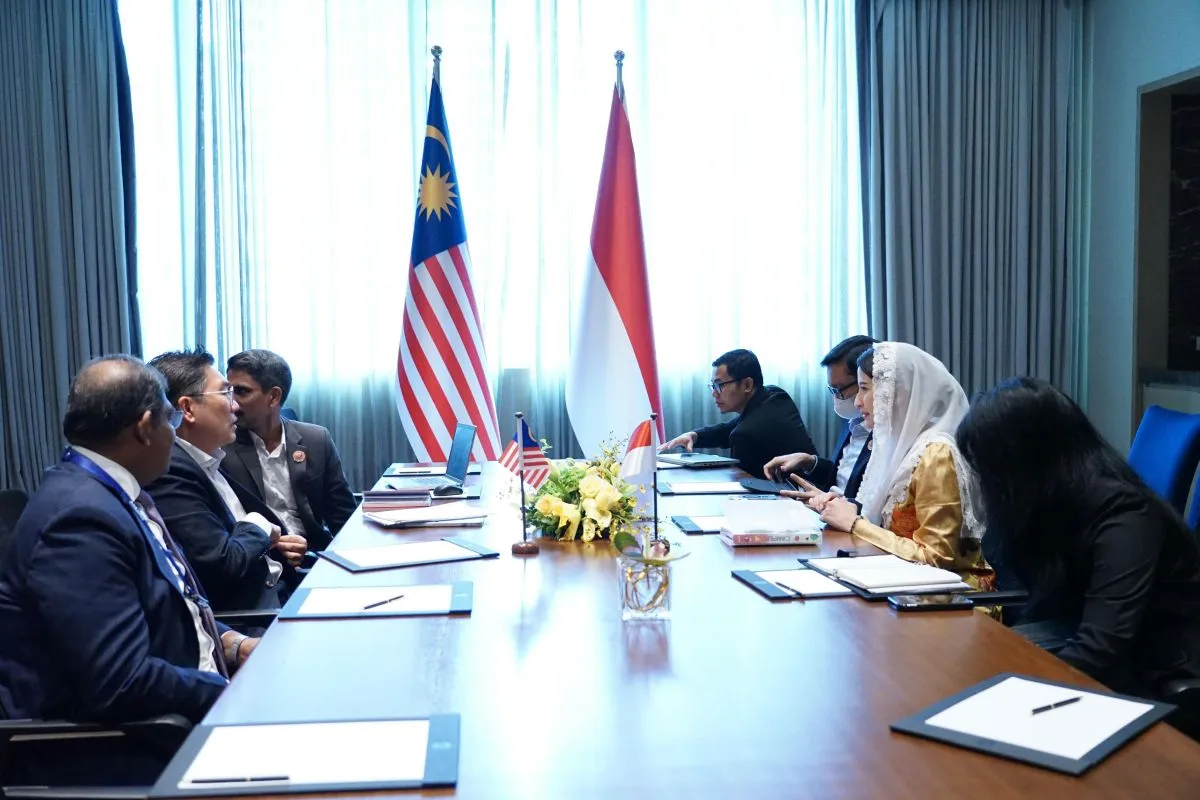
Indonesian Deputy Minister of Trade Dyah Roro Esti, in a meeting with Malaysia’s Deputy Minister of Investment, Trade, and Industry, Sim Tze Tzin (13/03/2026) (ANTARA/HO-Kemendag)
On March 15, Deputy Minister of Trade Dyah Roro Esti held bilateral talks with Deputy Prime Minister and Trade Minister Gan Kim Yong of Singapore and Deputy Minister of Investment, Trade and Industry Sim Tze Tzin of Malaysia to strengthen regional trade and investment cooperation. The meetings took place on the sidelines of the ASEAN Economic Ministers Retreat in Taguig, the Philippines, hosted by the Association of Southeast Asian Nations.
During discussions with Singapore, Esti highlighted the steady expansion of bilateral trade. Commerce between Indonesia and Singapore rose by 14.6% over the past five years, increasing from US$16.85 billion in 2020 to US$19.32 billion in 2025. Jakarta views Singapore as a key economic partner and aims to expand cooperation by promoting higher value-added exports and strengthening industrial linkages. Indonesia also reiterated its commitment to pursuing accession to the Comprehensive and Progressive Agreement for Trans-Pacific Partnership (CPTPP), which it sees as a pathway to deeper Indo-Pacific economic integration. Officials also discussed regional initiatives including negotiations on the ASEAN Digital Economy Framework Agreement and ongoing implementation of the Regional Comprehensive Economic Partnership.
In talks with Malaysia, Esti emphasised the strong economic relationship between the two neighbours. Bilateral trade reached US$24.22 billion in 2025, reflecting close supply chain links and cross-border economic activity. The two sides discussed expanding investment cooperation through the Malaysia–Indonesia Investment Committee and holding a Joint Trade and Investment Committee meeting. Progress on the 2023 Border Trade Agreement and efforts to normalise trade flows at the Entikong–Tebedu crossing were also reviewed.
Indonesia’s engagement with Singapore and Malaysia signals continued momentum for regional economic integration within Southeast Asia. Businesses may benefit from expanding market access and closer regulatory coordination as ASEAN economies deepen cooperation through frameworks such as RCEP and the planned ASEAN Digital Economy Framework Agreement. Indonesia’s push to diversify exports towards higher value-added sectors could create opportunities for technology partnerships, advanced manufacturing and supply chain development. Meanwhile, improved cross-border trade arrangements with Malaysia may facilitate smoother logistics and distribution for companies operating in border regions. Indonesia’s intention to pursue membership in the CPTPP may also introduce new trade standards while expanding access to global markets, potentially increasing competition but also offering wider export opportunities for firms operating in the region.
About The Author