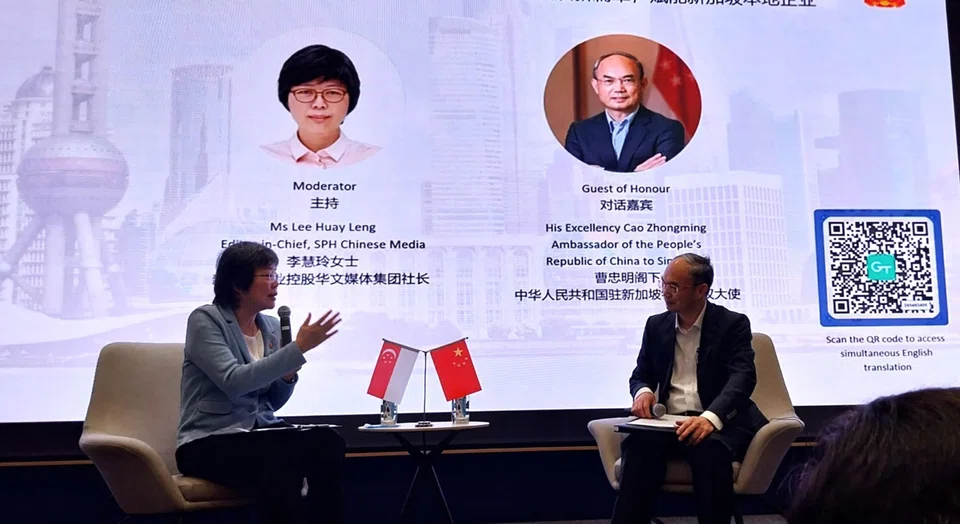
Lee Huay Leng (left), editor-in-chief of SPH Media’s Chinese Media Group, talks with China’s Ambassador to Singapore, Cao Zhongming on March 23. (Singapore Manufacturing Federation)
On March 23, China has unveiled its 15th Five-Year Plan following the conclusion of the “Two Sessions”, setting out its economic priorities for the next five years. The blueprint places strong emphasis on technological self-reliance, the development of emerging industries such as aerospace and quantum technology, and efforts to boost domestic consumption.
Officials have framed the plan as a bridge between China’s past growth model and its future direction. Speaking at a business event in Singapore, Chinese Ambassador to Singapore Cao Zhongming highlighted the plan’s role in providing policy continuity and greater predictability amid global uncertainty, including trade tensions and geopolitical risks. He also underscored China’s openness to foreign businesses, noting that Singapore firms have continued to find success in the Chinese market.
At the same time, business leaders pointed out that the plan carries both opportunities and challenges. While China remains a global manufacturing powerhouse, supported by strong output and a growing middle-income population, structural issues persist. Household consumption remains relatively low compared to advanced economies, reflecting income disparities and limitations in the social safety net.
As the plan unfolds, the government is expected to introduce measures to strengthen domestic demand, support small and medium-sized enterprises in digital transformation, and advance capabilities in key technologies. The plan also encourages deeper international collaboration, particularly in areas such as artificial intelligence, smart manufacturing, and green technology.
What does it mean for businesses?
For Singapore-based companies, this may increasingly involve co-development, joint innovation, and expansion into third markets rather than traditional export-led models.
However, challenges remain. Efforts to boost domestic consumption may take time to materialise, and regulatory as well as geopolitical uncertainties could affect market access. Businesses will need to navigate these dynamics carefully while aligning with China’s long-term strategic priorities.
About The Author