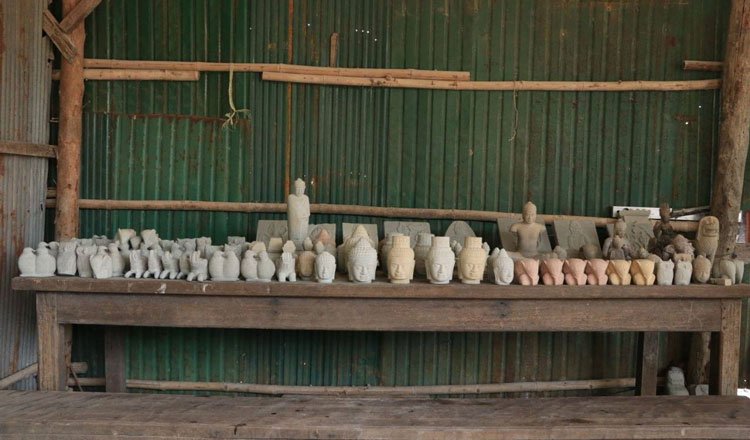
A shot of stone carving which continues to be preserved in Cambodia. (Khmer Times)
The Ministry of Culture and Fine Arts of Cambodia and the APSARA National Authority are supporting efforts to sustain traditional stone carving in Run Ta Ek Techo Sen City on April 1. The ancient Khmer craft continues to be preserved in Cambodia as authorities work to safeguard the centuries-old cultural practice while creating livelihood opportunities for local communities.
The initiative aims not only to preserve the ancient craft but also to provide stable income opportunities for local families and train young people to master stone carving techniques. Workshops in the village have become centres where experienced artisans pass down their knowledge to a new generation.
During the visit, Sek Sen, who runs a stone-carving workshop in the village, said he learned both stone and wood carving more than two decades ago while studying at Artisans Angkor in Siem Reap. Since then, he has developed expertise in intricate carving techniques, producing detailed works such as floral motifs, apsaras, deities, animals and other figures inspired by traditional Khmer artistic principles found in ancient temples and historic structures.
He expressed appreciation for the government’s support, which has enabled him to train young apprentices and pass on the knowledge he has acquired over the years. Through continuous training, he hopes more young people will take up the craft, which he believes offers both meaningful work and long-term career prospects.
One of his students, Sek Kin, said that after six months of training he can already carve animal figures and decorative patterns. He noted that the skill provides better earning potential compared with his previous work in construction.
Although support for the workshop is expected to continue for the next three years, the number of young trainees remains limited. The APSARA National Authority said the survival of Khmer stone carving depends on the next generation’s willingness to learn and preserve this valuable intangible heritage.
About The Author